


If someone just texted you “yu” and you’re staring at your phone trying to figure out what it means, you’re not alone. It’s one of the most common shorthand terms floating around DMs, group chats, and comment sections right now, and it’s simpler than it looks.
Quick Answer: YU is texting shorthand for “you.” People drop the “o” to type faster, especially on mobile keyboards where autocorrect sometimes turns “you” into “yu” on its own. It’s casual, low-effort, and shows up constantly in texts, Snapchat captions, TikTok comments, and gaming chats.
That’s the short version, but YU carries different weight depending on who sends it, where it’s sent, and what comes before or after it. Below, we’ll break down every angle: what it means from a girl versus a guy, how to reply, when it reads as rude, and the lesser-known meanings people often overlook.
What Does YU Mean in Text? 📱
At its core, YU is a phonetic shortcut. Typing “you” takes four keystrokes; “yu” takes two, and on a phone screen, that difference adds up fast when you’re texting all day.
You’ll usually see it in place of “you” inside short reactions or questions:
- “wyd” → “wyd yu?” (what are you doing, you?)
- “miss yu” (miss you)
- “is that yu?” (is that you)
It’s not a formal word you’ll find in a dictionary with one fixed rule. Instead, it’s part of a broader texting habit where vowels get trimmed to save time — similar to how “ur” replaces “your” or “u” replaces “you” entirely. YU just happens to be the version that keeps a little more of the original spelling.
Yu Meaning in Text From a Girl 👧
When a girl texts “yu,” context does most of the work. On its own, “yu” is neutral — it’s just a fast way of saying “you.” But paired with certain phrases, it can carry warmth or flirtation:
- “stop it, yu” — playful, teasing tone
- “yu’re so funny” — casual compliment, often friendly rather than romantic
- “I was thinking about yu” — this one leans affectionate, especially in a one-on-one chat
The safest read: don’t assume romantic interest just because someone used “yu” instead of “you.” It usually reflects how fast someone types, not how they feel. The surrounding words, emojis, and response time tell you far more than the abbreviation itself.
Yu Meaning in Text From a Guy 👦
Guys tend to use “yu” the same way — as a speed shortcut — but it often shows up in shorter, more clipped messages overall. A guy might text:
- “yu good?” (checking in, casual concern)
- “yu up?” (late-night text, could be casual or flirty depending on the relationship)
- “yu did that 😂” (praise or hype after something impressive)
In group chats or gaming lobbies, guys frequently use “yu” in fast-paced banter where every message is short by default. The meaning stays consistent — it’s still just “you” — but tone comes from punctuation, emojis, and timing rather than the word choice itself.
Yu Meaning Urban Dictionary 📖

Slang dictionaries generally list YU as an informal spelling variant of “you,” sometimes noting it appears when autocorrect intervenes or when someone is typing quickly on a small keyboard. Entries on crowdsourced slang sites tend to agree it’s not a coded term with a hidden second meaning — it’s a straightforward abbreviation, though some users have listed joke or ironic definitions for it over the years.
Because these platforms rely on user submissions, definitions can vary in quality and tone. Treat crowdsourced entries as a starting point, not a final authority, since the community-driven format means less common or joke entries sometimes rank alongside the accurate ones.
Where Is YU Commonly Used? 🌍
YU isn’t tied to one single app — it travels across nearly every platform where fast, informal typing is the norm.
Popular Platforms 📲
- Snapchat: Common in chat and captions, especially paired with streaks or quick check-ins
- TikTok: Shows up in comments reacting to videos (“yu did not just say that”)
- Instagram: Used in DMs and story replies
- Discord & gaming chats: Frequent in fast-moving text channels during matches
- SMS/iMessage: Appears in everyday texting, often triggered by autocorrect
Tone & Style 🎭
Across all these platforms, YU carries an informal, low-pressure tone. It’s rarely used in professional messages, formal emails, or first-time introductions. Think of it as belonging to the same casual register as “lol,” “idk,” or “brb” — appropriate among friends, less appropriate with a boss, teacher, or new acquaintance.
Examples of YU in Conversation 💭

Seeing YU in real exchanges makes the meaning click faster than any definition alone.
Example 1 — Friendly check-in
Person A: hey yu good?
Person B: yeah just tired, yu?
Meaning: A casual “how are you” exchange between friends, no deeper subtext.
Example 2 — Flirty tone
Person A: can’t stop thinking bout yu 👀
Person B: stoppp lol
Meaning: Here, “yu” sits inside a clearly flirtatious message — the romantic tone comes from the phrasing and emoji, not the word itself.
Example 3 — Gaming chat
Person A: yu see that play??
Person B: bro I KNOW
Meaning: Fast, excited reaction during gameplay, purely functional use of “yu.”
Example 4 — Slightly annoyed tone
Person A: why would yu even say that
Meaning: Same abbreviation, but the message before it (a pointed question) shifts the tone toward frustration.
When to Use and When Not to Use YU ✅❌
When to Use YU
- Texting close friends or people you talk to casually and often
- Fast-paced chats like gaming lobbies or group threads
- Social media comments and captions where a relaxed tone fits
- Quick replies where formality isn’t expected
When Not to Use YU
- Messaging a teacher, boss, or client
- First conversations with someone you don’t know well
- Job applications, cover letters, or professional emails
- Any situation where clarity and formality matter more than speed
Other Meanings of YU in Text 🔤
While “you” is by far the most common meaning, YU shows up in a few other contexts worth knowing:
- A name or nickname: Yu is a real given name in Japanese and Chinese, and some people go by “Yu” as a nickname — context (like a name in a group chat) usually makes this obvious.
- YU as an abbreviation for institutions: Several universities use “YU” as shorthand, including Yale, Yeshiva, and York University, so “YU” in a school-related chat might refer to a college, not the pronoun.
- Gaming or anime references: In some fan communities, “Yu” refers to a character name (as in certain anime and game franchises), so context inside fandom spaces matters.
If “yu” seems out of place given the conversation, it’s worth checking whether it’s being used as a name rather than the word “you.”
Similar Slang Words or Alternatives To Yu
| Slang | Meaning | Typical Use |
| U | You | Even shorter, very common in fast texts |
| Ur | Your / You’re | Used for possession or contraction |
| Yh | Yeah | Quick agreement |
| Yu | You | Slightly less common than “u,” keeps more original spelling |
| Ya | You / Yeah (context-dependent) | Regional, casual tone |
The main difference between “yu” and “u” is subtle: “u” is the most stripped-down version, while “yu” keeps a bit more of the word’s shape. Some people default to one or the other simply based on typing habit or which one autocorrect suggests most often.
Why Do People Use YU in Texting? ⚡
1. Faster Typing 🏎️
Dropping a letter saves time, especially for people who text constantly throughout the day. Multiply that saved keystroke across hundreds of messages, and the habit sticks.
2. Casual Communication 😎
Shortened spelling signals an informal, relaxed tone. It tells the other person “this is a low-stakes conversation,” which matches how most texting between friends actually feels.
3. Internet Culture 🌐
Texting shorthand spreads through shared exposure — comment sections, group chats, and viral posts normalize spellings like “yu” until they become second nature for entire friend groups or online communities.
4. Gaming & Social Media 🎮
Fast-paced environments like live gaming chats or comment threads reward speed over polish, so trimmed words like “yu” fit naturally into that rhythm.
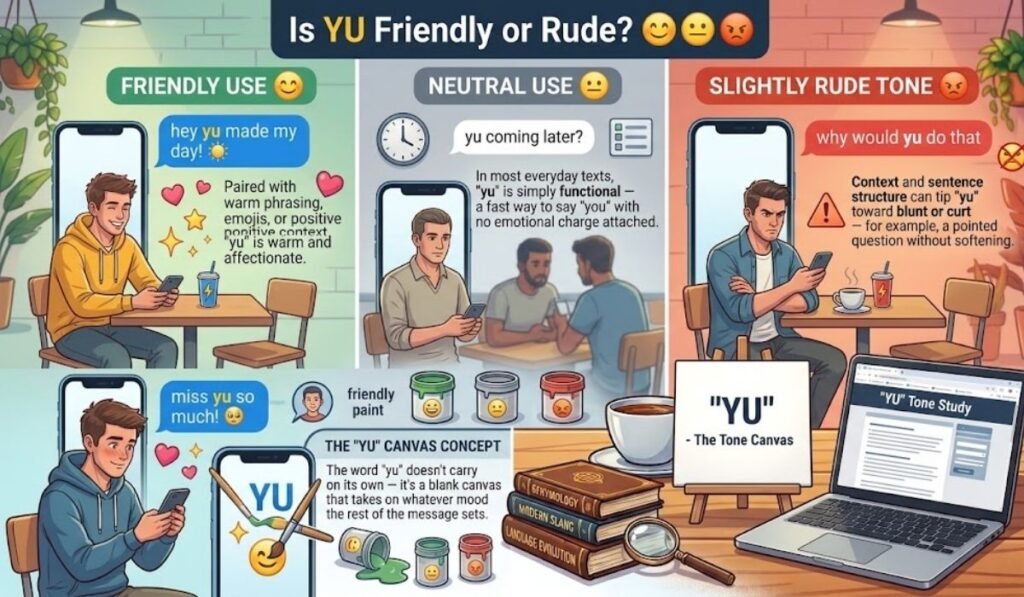
Is YU Friendly or Rude? 😊😐😠
Friendly Use
Paired with warm phrasing, emojis, or a positive context, “yu” reads as friendly: “miss yu 🥹” or “yu’re the best.”
Neutral Use
In most everyday texts, “yu” is simply functional — a fast way to say “you” with no emotional charge attached, like “yu coming later?”
Slightly Rude Tone
Context can tip “yu” toward blunt or short — for example, “why would yu do that” without any softening punctuation or emoji can come across as curt, mainly because of the sentence structure, not the abbreviation itself.
The word “yu” doesn’t carry tone on its own — it’s a blank canvas that takes on whatever mood the rest of the message sets.
Why Some People Get Confused by YU 🤔
Confusion around “yu” usually comes down to a few factors. First, autocorrect sometimes changes “you” to “yu” unintentionally, so readers assume it’s a typo rather than an intentional stylistic choice. Second, because “yu” overlaps with real names, surnames, and even university abbreviations, readers unfamiliar with texting shorthand may misread it entirely. Third, older or less texting-fluent readers may not immediately connect “yu” with “you” the way younger, more digitally fluent texters do — generational familiarity with shorthand plays a real role in how quickly someone decodes it.
Frequently Asked Questions About YU Meaning
What does YU mean in a text message?
YU is informal shorthand for “you,” used to type faster in casual conversations. It shows up across texting apps, social media comments, and gaming chats, and doesn’t carry a hidden or secret meaning beyond the pronoun itself.
Is YU the same as U in texting?
They’re closely related — both mean “you” — but “u” is the more stripped-down version, while “yu” keeps slightly more of the original word’s shape. Which one someone uses often just comes down to habit or autocorrect.
Does YU mean something different from a girl or a guy?
No, the core meaning stays the same regardless of who sends it. Tone differences come from the surrounding message, emojis, and context, not from the gender of the sender.
Is it rude to text someone “yu”?
Not inherently. “Yu” is neutral on its own; rudeness comes from tone, punctuation, or the message it’s paired with, not the abbreviation itself.
Why did my phone autocorrect “you” to “yu”?
Some keyboards learn from frequent typing patterns, and if you’ve typed “yu” often, your phone may start suggesting or defaulting to it, even when you meant to type “you” in full.
Can YU mean something other than “you”?
Occasionally. “Yu” can be a name, part of a university abbreviation (like Yale or York University), or a character name in certain gaming and anime communities, though “you” remains the overwhelmingly common meaning in everyday texts.
Is YU used more by Gen Z?
Shorthand like “yu” is more common among younger, mobile-first texters who grew up typing quickly on smartphones, but it’s not exclusive to any one age group — plenty of casual texters of all ages use it.
How do I reply if someone texts me “yu”?
Reply naturally, treating “yu” as “you.” For example, if someone texts “yu up?” a simple “yeah, what’s up?” works fine — there’s no special reply format required.
Final Thoughts
YU is one of those texting shortcuts that looks confusing for about five seconds and then makes complete sense once you see it in context — it’s just “you,” typed fast. The real skill isn’t decoding the word itself but reading the tone around it, since the same two letters can sound warm, neutral, or blunt depending on what surrounds them. Once you get comfortable with that, you’ll never second-guess a “yu” text again.
