
You’re texting a friend, scrolling TikTok, or wrapping up a game, and someone drops “WP” into the chat. It looks simple, but the meaning shifts depending on where you saw it — which is exactly why so many people stop mid-conversation to Google it.
Quick Answer ⚡
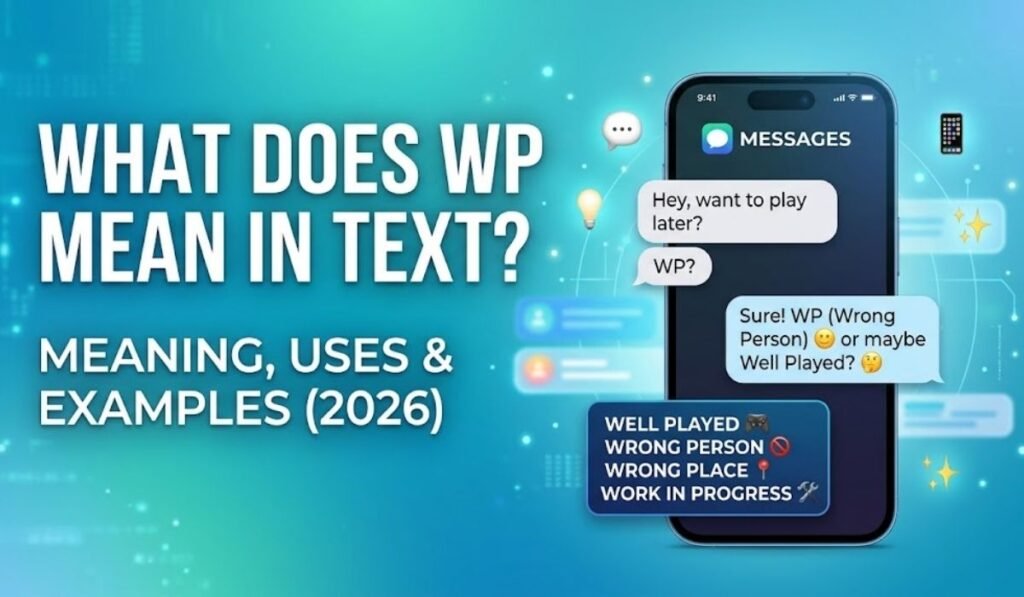
WP most commonly means “Well Played,” a casual compliment used after a game, a smart move, or a strong effort. It can also stand for “Wrong Person” (when a text was sent to the wrong contact), “WordPress” (in web design chats), or “WhatsApp” (rarely, as a shorthand). Context tells you which one applies.
What Does WP Mean in Text? 💬
In everyday texting, WP almost always means “Well Played.” It’s a short way to acknowledge that someone did something well, without turning it into a big deal. Think of it as a fist bump in text form — quick, low-effort, and genuine.
You’ll see it after someone wins a bet, nails a comeback, or pulls off something clever in conversation. It doesn’t require a long reply, which is exactly why it caught on. In fast-moving group chats, a two-letter compliment keeps the pace going without breaking the flow.
Outside of gaming and casual chat, WP occasionally shifts meaning entirely — more on that below.
WP Meaning in Social Media 📱
On social platforms, WP usually keeps its “Well Played” meaning, but it shows up in slightly different situations than texting. People use it in comment sections after someone posts a clever comeback, a witty caption, or a clean edit. It’s also common under gaming clips, where viewers drop “WP” to praise a good play they just watched.
Because social media comments are public, WP here often carries a slightly more performative tone — it’s not just praise for the poster, it’s a way for the commenter to show they understood the skill or humor involved.
WP Meaning in School 🏫
Among students, WP typically keeps the same “Well Played” meaning but gets applied to schoolwork, sports, or friendly rivalries. A classmate might text “WP” after you ace a pop quiz, win a debate point, or beat them in a class trivia game.
Less commonly, in some school group chats, WP is used as “Wrong Person” when a student accidentally sends a message meant for someone else — a mix-up that happens constantly in busy class chats with dozens of members.
WP Meaning in Game 🎮
Gaming is where WP started, and it’s still the term’s home base. In multiplayer titles like League of Legends, Valorant, and Call of Duty, players type “WP” at the end of a match to acknowledge that the opposing team or a teammate played well — regardless of who won.
It sits alongside “GG” (Good Game) as one of the two standard sign-offs players use after a match, and skipping it is sometimes seen as a small breach of gaming etiquette, especially in competitive lobbies.
Where Is WP Commonly Used? 📍
Popular Platforms
- Gaming chat and voice comms (League of Legends, Valorant, Fortnite, Call of Duty)
- Texting apps (iMessage, Android Messages)
- Social media comments (TikTok, Instagram, Snapchat)
- Group chats among friends, classmates, or teammates
- Discord servers, especially gaming and esports communities
Tone & Style
WP is informal by nature. It’s written in lowercase or uppercase interchangeably (“wp” and “WP” mean the same thing), rarely gets punctuation, and is often paired with emojis like 👏, 😂, or 🎮 to clarify tone. It’s not used in formal writing, professional emails, or anywhere a complete sentence is expected.
Examples of WP in Conversation 🗨️
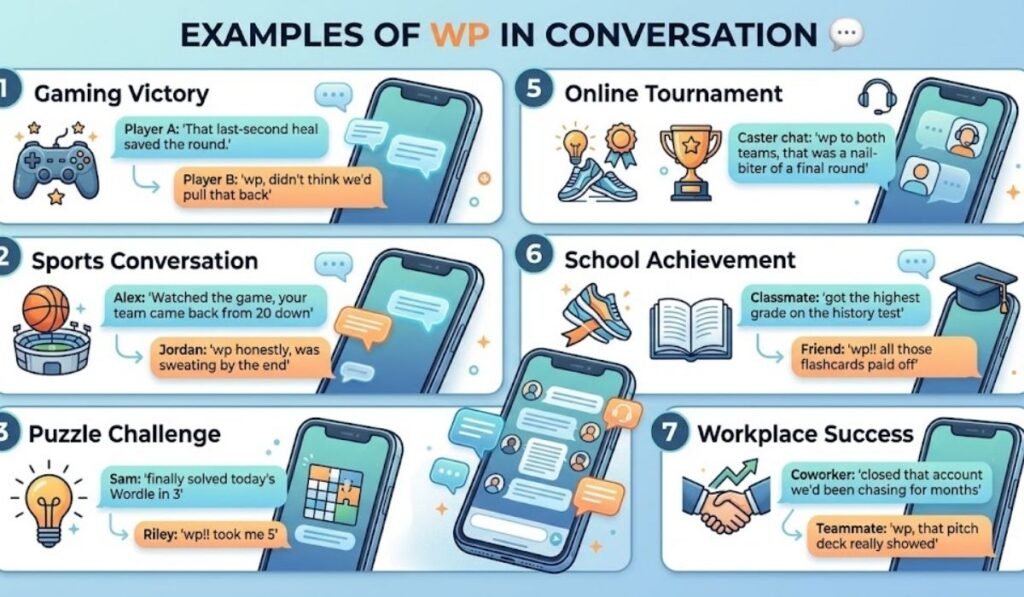
1. Gaming Victory
Player A: That last-second heal saved the round.
Player B: wp, didn’t think we’d pull that back
2. Sports Conversation
Alex: Watched the game, your team came back from 20 down
Jordan: wp honestly, was sweating by the end
3. Puzzle Challenge
Sam: finally solved today’s Wordle in 3
Riley: wp!! took me 5
4. Friendly Competition
Mia: beat your high score btw
Theo: wp, guess I’m buying lunch
5. Online Tournament
Caster chat: wp to both teams, that was a nail-biter of a final round
6. School Achievement
Classmate: got the highest grade on the history test
Friend: wp!! all those flashcards paid off
7. Workplace Success
Coworker: closed that account we’d been chasing for months
Teammate: wp, that pitch deck really showed
When to Use and When Not to Use WP ✅❌
When to Use WP
- After a game, match, or friendly competition ends
- To compliment a clever comment, comeback, or idea
- In casual texts with friends, teammates, or classmates
- As a quick, low-pressure acknowledgment instead of a long reply
When Not to Use WP
- In formal emails, job applications, or professional documents
- With someone who may not know internet slang, like older relatives
- In situations where the “Wrong Person” meaning could confuse the reader
- When a genuine, detailed response is expected instead of a two-letter reply
Other Meanings of WP in Text 🔄
WP isn’t a one-definition abbreviation. Depending on the conversation, it can shift into a completely different meaning, so it’s worth knowing all of them before assuming “Well Played” every time.
WP Meaning: “Wrong Person” 🙅
Sometimes WP has nothing to do with games or compliments. It’s shorthand for “Wrong Person,” typed when someone realizes a message wasn’t meant for the recipient — a common mix-up in group chats or when scrolling through multiple conversations at once.
Example:
Text received: “Don’t forget to pick up the cake for tonight!”
Reply: “wp, sorry! meant to send that to my sister”
WP Meaning: “WordPress” 💻
In website-building and blogging conversations, WP is shorthand for WordPress, the content management system that powers a large share of websites worldwide. This usage shows up in developer forums, freelancer chats, and small-business discussions about building or fixing a site.
Example:
Client: Can you fix the contact form on the site?
Developer: Sure, it’s a WP plugin issue, I’ll update it today
WP Meaning: “WhatsApp” 📞
Less common, but still used in some regions, WP occasionally stands in for WhatsApp, especially when people are quickly asking which app to continue a conversation on.
Example:
Friend: Can’t talk here, send me the details on WP instead
You: ok, messaging you there now
Similar Slang Words or Alternatives 🔁
| Slang | Meaning | Typical Use |
| GG | Good Game | End of a match, win or lose |
| NP | No Problem | Response to thanks |
| GLHF | Good Luck, Have Fun | Start of a match |
| Nice | General praise | Any context, casual |
| Solid | Praise for effort or skill | Casual chat, gaming |
| Respect | Acknowledging a good move | Gaming, social media |
WP and GG often appear together (“gg wp”) at the end of a match, but they’re not interchangeable — GG comments on the overall match, while WP praises specific performance or skill.
Why Do People Use WP Instead of “Well Played”? ⏱️
1. Saves Time
Typing two letters is faster than typing eleven, which matters in fast-paced chats or mid-match communication.
2. Gaming Culture
WP became a standard part of online gaming etiquette long before it spread to general texting, giving it built-in recognition among players.
3. Faster Conversations
Abbreviations keep group chats and comment sections moving without slowing everyone down with full sentences.
4. Universal Meaning
Because it originated in international gaming communities, WP is understood across language barriers in a way longer phrases aren’t.
5. Positive Sportsmanship
Typing WP after a loss signals good sportsmanship — it shows respect for the other player’s skill without needing a paragraph to explain it.
Is WP Friendly or Rude? 🙂
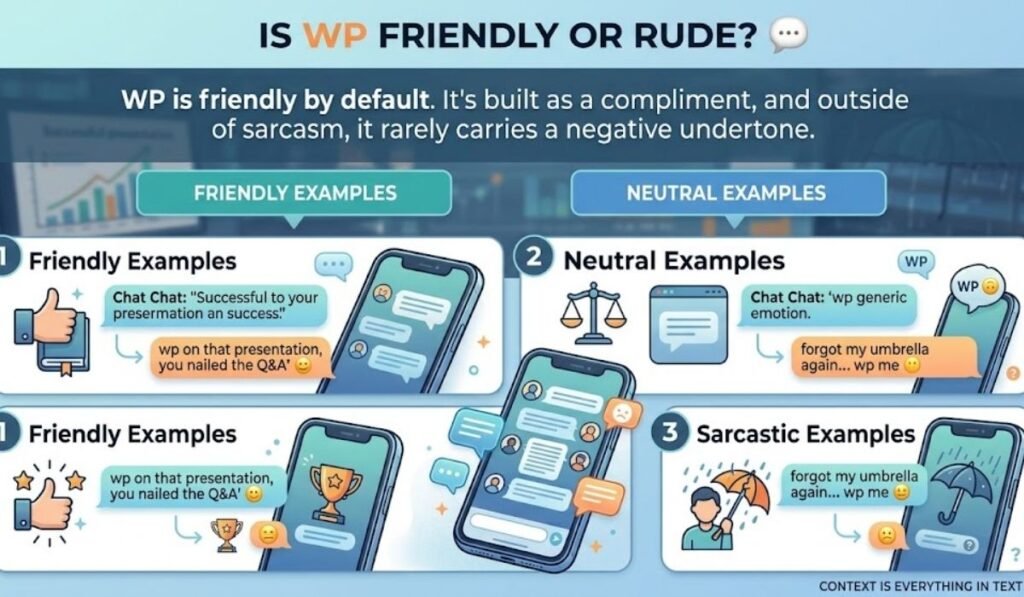
WP is friendly by default. It’s built as a compliment, and outside of sarcasm, it rarely carries a negative undertone.
Friendly Examples
“wp on that presentation, you nailed the Q&A”
Neutral Examples
“wp” (sent after a match with no other context)
Sarcastic Examples
“forgot my umbrella again… wp me 🙃”
Context Matters
The tone of WP depends entirely on what surrounds it. Paired with an eye-roll emoji or used after an obvious mistake, it flips into light sarcasm. Sent right after a real win, it’s sincere praise. Reading the rest of the message — and the relationship between the people texting — usually makes the intended tone obvious.
How WP Is Used on Social Media 📲
Snapchat
Typically appears in chat replies after a friend shares a win, a good grade, or a funny Snap.
TikTok
Shows up in comments under gaming clips, challenge videos, or comeback moments, praising the creator’s skill or timing.
Used in DMs or comments, often after a post showing an achievement, competition result, or creative project.
Gaming Platforms
The most traditional use — typed in post-match chat on platforms like Steam, Xbox Live, or in-game text boxes.
Occasionally doubles as shorthand for the app itself, but within WhatsApp chats, it still usually means “Well Played.”
How to Reply to WP 💭
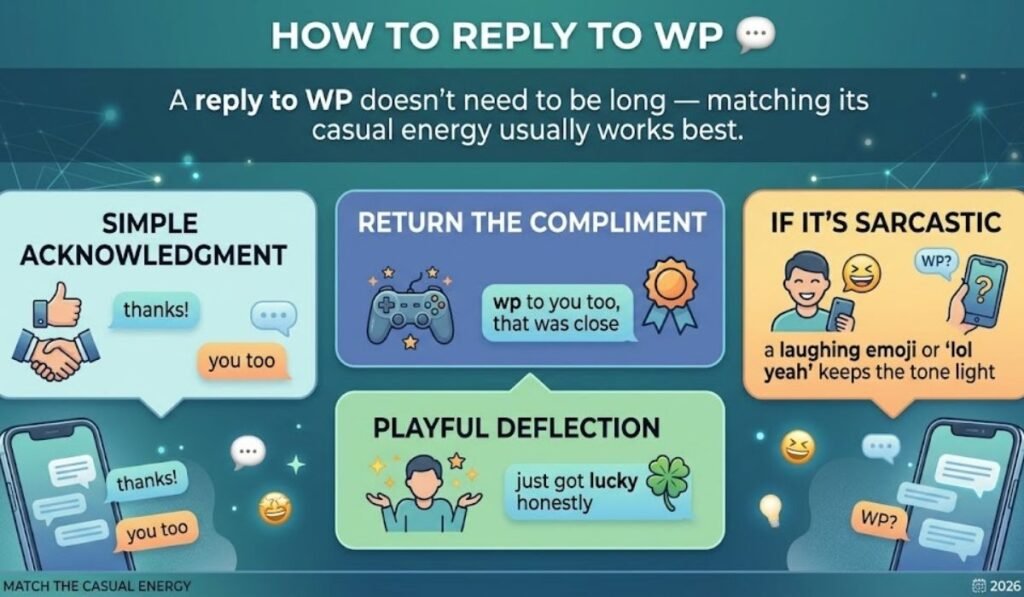
A reply to WP doesn’t need to be long — matching its casual energy usually works best.
- Simple acknowledgment: “thanks!” or “you too”
- Return the compliment: “wp to you too, that was close”
- Playful deflection: “just got lucky honestly”
- If it’s sarcastic: a laughing emoji or “lol yeah” keeps the tone light
If you’re unsure which meaning was intended, a quick “wp meaning?” is a normal, non-awkward way to clarify.
Origin of WP: Where Did It Come From? 🕹️
WP traces back to early online multiplayer gaming culture in the late 1990s and 2000s, when players in real-time strategy and first-person shooter communities needed quick, typing-friendly ways to communicate mid-match. “GG” and “WP” became standard sign-offs because they were fast to type and universally understood, regardless of a player’s first language. As gaming chat habits spread into broader internet culture through streaming, esports commentary, and social platforms, WP moved beyond game lobbies and into everyday texting.
Common Misunderstandings About WP ⚠️
- Assuming it always means “Well Played.” In non-gaming contexts, especially group chats, “Wrong Person” is just as likely.
- Reading it as rude without context. WP is rarely meant as an insult, even when it sounds blunt on its own.
- Missing regional differences. In some regions and industries, WP defaults to WordPress or WhatsApp rather than gaming slang.
- Treating it as gender- or age-specific. WP carries the same meaning no matter who sends it — tone comes from context, not the sender.
Frequently Asked Questions About WP Mean in Text
What does WP mean in a text message from a girl or guy?
WP means the same thing regardless of who sends it — usually “Well Played.” The sender’s gender doesn’t change the meaning; the surrounding conversation does.
Does WP mean “Well Played” in every context?
No. While it’s the most common meaning, WP can also mean “Wrong Person,” “WordPress,” or “WhatsApp,” depending on the topic being discussed.
Is WP used more by gamers or in general texting?
It originated in gaming but has spread widely into general texting and social media, though gaming communities still use it most consistently.
What’s the difference between WP and GG?
GG (“Good Game”) comments on the match overall, while WP (“Well Played”) praises specific skill or effort — they’re often used together but aren’t identical.
Can WP be sarcastic?
Yes. Paired with certain emojis or sent after an obvious mistake, WP can carry a light, joking sarcasm rather than genuine praise.
Is it okay to use WP in a professional setting?
Generally no. WP is casual slang and doesn’t fit formal emails or workplace documents, though it’s sometimes used informally between coworkers who are close.
What does WP mean on Snapchat or TikTok specifically?
On both platforms, WP almost always means “Well Played,” typically used in comments or chat replies to praise something impressive.
How do I know which meaning of WP someone intended?
Look at the conversation topic. Gaming or achievement talk points to “Well Played”; a misdirected message points to “Wrong Person”; web design talk points to “WordPress.”
Final Thoughts
WP is one of those abbreviations that only takes a second to type but carries real context depending on where it shows up. Most of the time, it’s a compliment — a quick “well played” between friends, teammates, or strangers in a game lobby. Keep an eye on the conversation around it, and the right meaning becomes obvious almost every time.
