
You got a text back that just said “STY” and now you’re stuck staring at your phone trying to decode it. It happens to everyone — texting slang moves faster than most people can keep up with, and three random letters can feel like a tiny mystery.
Good news: it’s not complicated. Here’s exactly what STY means, when people use it, and how to reply without sounding lost.
Quick Answer 🎯
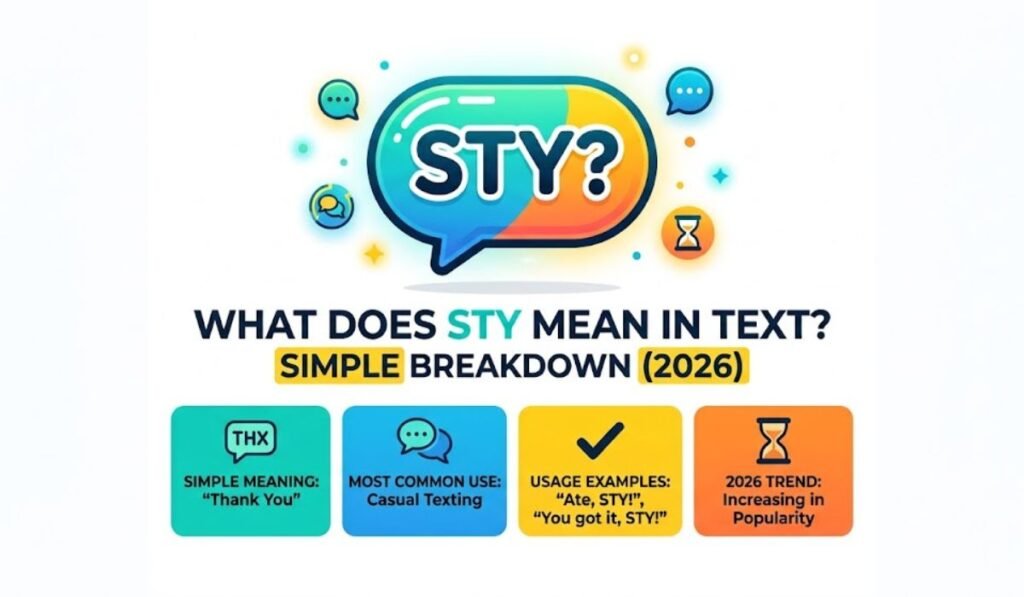
STY mean in text is almost always “Same To You.” People send it to mirror a wish, compliment, or greeting someone just sent them — like replying to “have a good day” without retyping the whole phrase. It’s casual, quick, and works for both nice comments and playful comebacks.
What Does STY Mean in Text?
STY stands for “Same To You.” It’s an initialism, so people say each letter on its own — “S, T, Y” — rather than pronouncing it as a word.
The whole point of STY is to bounce a sentiment right back at someone. If a friend wishes you good luck, a good night, or a great weekend, typing “STY” tells them you’re wishing the exact same thing back, minus the extra typing.
Example:
A: Have a great weekend! 🎉
B: STY! Enjoy yours too 😊
Why People Use STY
Texting rewards speed. Nobody wants to type out “same to you, hope you have a wonderful time too” when three letters do the job just as well. STY also feels a bit warmer and more casual than a full sentence — it reads like a quick, easy reply between people who already have a relaxed rhythm going.
There’s also a habit factor. Once someone starts using STY, it tends to stick because it’s short, universally understood in casual chats, and doesn’t require any real thought to type.
Sty Meaning in Chat From a Boy
Context matters more than gender here, but when a guy sends STY in a chat, it usually plays out one of two ways. If the conversation is friendly — talking about plans, sports, school, or just catching up — STY is simply a quick “you too” with zero hidden meaning.
If the conversation has a flirty undertone already, STY can carry that same energy. For example, if a girl texts “you looked really good today” and a guy replies “STY,” he’s returning the compliment in a low-key, almost shy way rather than writing out something more elaborate. The acronym itself isn’t flirty — the surrounding conversation is what shapes the tone.
Sty Meaning Slang TikTok
On TikTok, STY shows up mostly in comment sections and captions as a fast way to reply to compliments or well-wishes, same as it’s used in DMs and texts. You’ll also see creators using “STY” in response to shoutouts or supportive comments, like replying to “love your content!” with “STY, appreciate you 💛”
TikTok’s fast-scroll culture makes short acronyms like this even more common — commenters often have limited character space or just want to reply quickly before moving to the next video, so STY fits naturally into that rhythm.
Sty Meaning Gen Z
For Gen Z texters, STY isn’t really “new” slang in the trendy sense — it’s more of a texting staple that’s been passed down and is still used because it’s efficient. Gen Z tends to use it interchangeably with “u2” (you too), often switching between the two depending on mood or who they’re texting.
One thing that sets Gen Z usage apart is how casually it’s dropped into group chats, not just one-on-one conversations. It’s common to see it as a quick reaction to an announcement, a birthday shoutout, or someone sharing good news in a group thread.
Where Is STY Commonly Used?
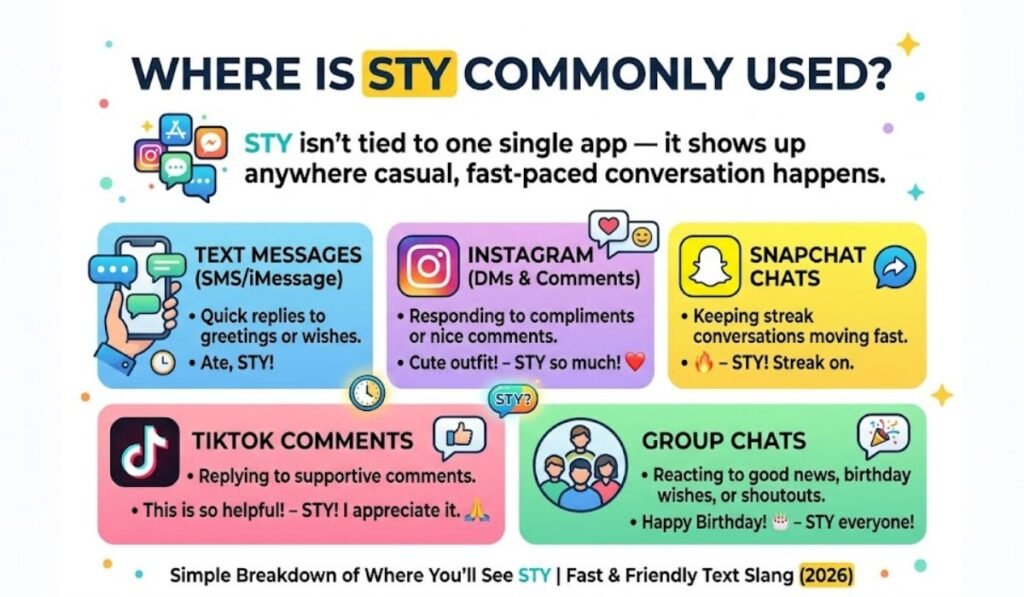
STY isn’t tied to one single app — it shows up anywhere casual, fast-paced conversation happens.
Popular Places You’ll See STY
- Text messages (SMS/iMessage) — quick replies to greetings or wishes
- Instagram DMs and comments — responding to compliments or nice comments
- Snapchat chats — keeping streak conversations moving fast
- TikTok comment sections — replying to supportive comments
- Group chats — reacting to good news, birthday wishes, or shoutouts
Communication Style
STY fits best in low-effort, high-frequency conversations — the kind where you’re texting back and forth quickly and don’t want every reply to feel like a full sentence. It signals familiarity and comfort between the people texting, which is part of why it feels natural in close friendships or casual dating chats but slightly out of place in more formal exchanges.
Examples of STY in Conversation
Seeing STY in different situations makes the meaning click faster than any definition alone.
Example 1
A: Good luck on your exam tomorrow!
B: STY, you’ve got this too 🙏
Example 2
A: You’re actually really talented, ngl.
B: STY lol, stop 😳
Example 3
A: Get home safe!
B: STY, text me when you’re back too.
Example 4
A: Hope your interview goes well!
B: STY, fingers crossed for us both 😅
Example 5
A: I hope your day sucks 🙄
B: STY. real mature.
Example 6
A: Happy anniversary to you guys!
B: STY, thanks for remembering 🥰
Notice the pattern — STY almost always shows up right after a wish, compliment, greeting, or occasionally a sarcastic jab, and it works to return whatever energy was just sent.
When to Use and When Not to Use STY
When to Use STY
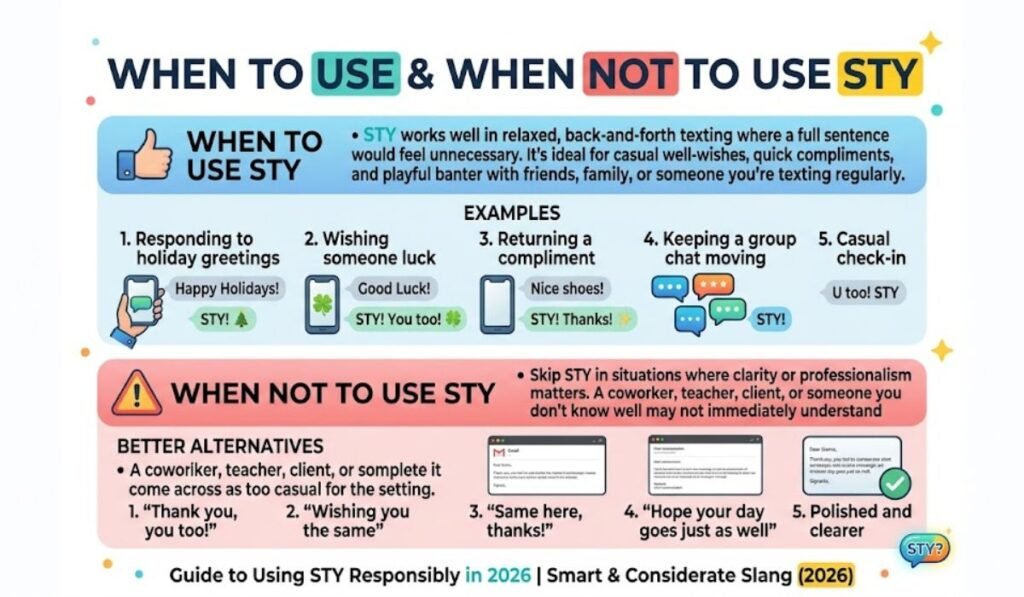
STY works well in relaxed, back-and-forth texting where a full sentence would feel unnecessary. It’s ideal for casual well-wishes, quick compliments, and playful banter with friends, family, or someone you’re texting regularly.
Examples
- Responding to holiday greetings
- Wishing someone luck after they wish you luck
- Returning a compliment quickly
- Keeping a fast-paced group chat moving
When Not to Use STY
Skip STY in situations where clarity or professionalism matters. A coworker, teacher, client, or someone you don’t know well may not immediately understand the abbreviation, and even if they do, it can come across as too casual for the setting.
Better Alternatives
- “Thank you, you too!”
- “Wishing you the same”
- “Same here, thanks!”
- “Hope your day goes just as well”
These options sound more polished and are safer choices in emails, work Slack messages, or first-time conversations with someone new.
Other Meanings of STY in Text
“Same To You” is by far the most common meaning, but STY isn’t locked to just one definition. Depending on the conversation, people occasionally use it loosely to mean things like “stick to yourself” in specific slang circles, though this usage is far less common and highly context-dependent.
Outside of texting slang entirely, “sty” is also a regular English word referring to a pigpen, or informally, a messy space — as in “clean up this sty of a room.” It’s also the everyday spelling some people use for a “stye,” the eyelid bump caused by a blocked oil gland.
Example
A: Your room looks like a sty 😩
B: I know, I’ll clean it this weekend.
Here, “sty” has nothing to do with texting slang at all — it’s just describing a messy space, which is why reading the full sentence around it matters.
Why Is STY So Popular?
STY has stuck around because it checks every box people want from texting slang: it’s short, instantly understood by anyone familiar with common abbreviations, and flexible enough to fit both sincere and sarcastic replies.
Benefits of Using STY
- Saves time typing out a full response
- Feels casual and natural in fast conversations
- Works across almost every messaging platform
- Easily understood across different age groups now, not just younger texters
Is STY Friendly, Flirty, or Formal?
Friendly
Most of the time, STY is simply friendly. It’s the digital version of nodding and saying “you too” — quick, warm, and low-pressure.
Flirty
STY can pick up flirty energy, but only because of what surrounds it. If someone sends a cute or teasing compliment and gets “STY” back with extra emojis or a longer pause before responding, that shift in tone (not the letters themselves) is what makes it feel flirty.
Formal
STY isn’t formal and shouldn’t be used in professional or unfamiliar settings. Spelling out “thank you, same to you” reads far more appropriately in emails, work chats, or messages to people you don’t know casually.
Similar Slang Words or Alternatives
A few other abbreviations do a similar job to STY, though each has slightly different nuance.
| Abbreviation | Meaning | Best Used For |
| U2 | You too | General replies to wishes or greetings |
| SM | Same | Very short agreement or reciprocation |
| DITTO | Same as what you said | Agreeing with a statement, not just a wish |
| S2 | Same to you (shorter variant) | Fast-paced texting, similar to STY |
Most Similar Alternative
“U2” is the closest match to STY in both meaning and tone — the two are often used interchangeably depending on personal texting habits rather than any real difference in meaning.
Why Context Matters When Reading STY
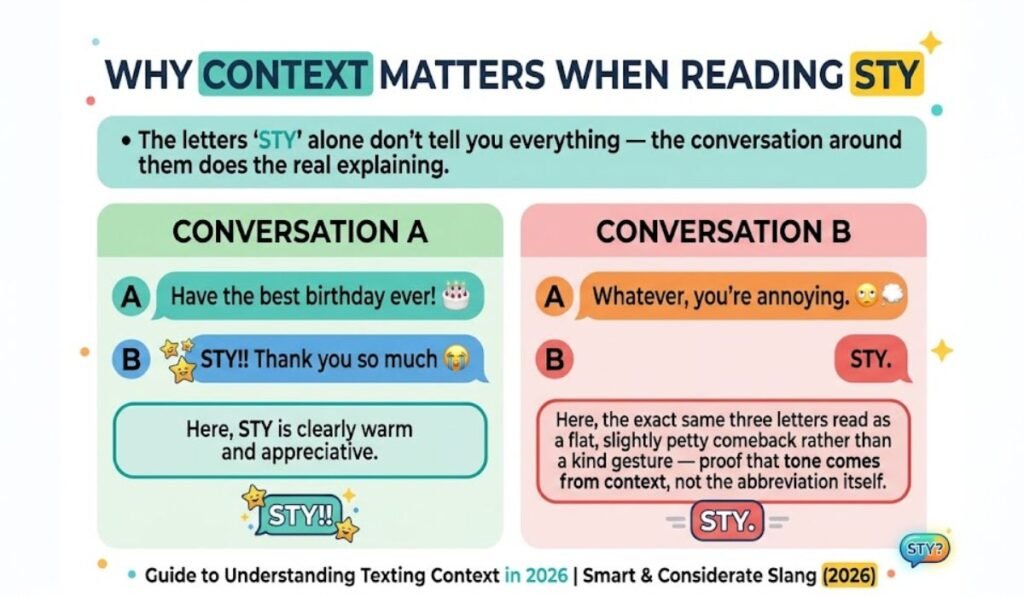
The letters “STY” alone don’t tell you everything — the conversation around them does the real explaining.
Conversation A
A: Have the best birthday ever! 🎂
B: STY!! Thank you so much 🥹
Here, STY is clearly warm and appreciative.
Conversation B
A: Whatever, you’re annoying.
B: STY.
Here, the exact same three letters read as a flat, slightly petty comeback rather than a kind gesture — proof that tone comes from context, not the abbreviation itself.
Frequently Asked Questions About STY Mean in Text
What does STY mean in a text message?
STY stands for “Same To You.” It’s a quick way to return a greeting, wish, or compliment without retyping a full sentence.
Is STY the same as U2?
Yes, both mean roughly the same thing. STY means “Same To You,” while U2 means “You Too” — they’re used interchangeably in most casual chats.
Does STY always mean something nice?
Not always. While STY is usually friendly, it can also be used sarcastically as a comeback to a negative or rude comment.
Can STY be flirty?
STY itself isn’t inherently flirty, but it can take on a flirty tone depending on the compliment or message it’s responding to.
Is it okay to use STY with a teacher or boss?
It’s better to avoid it. STY is casual slang, so spelling out “thank you, same to you” is a safer, more professional choice.
What does STY mean besides “Same To You”?
Outside of texting slang, “sty” is a regular word for a pigpen or a messy space, and it’s also a common spelling for “stye,” the eyelid bump.
Why do people use STY instead of typing it out?
It saves time and fits the fast, casual rhythm of texting, especially in back-and-forth conversations where quick replies keep the chat moving.
Is STY used the same way on every app?
Pretty much. STY means the same thing whether it shows up in a text, Instagram DM, Snapchat chat, or TikTok comment — only the tone shifts based on the platform’s overall vibe.
Final Thoughts
STY is one of those small texting shortcuts that says a lot in very little space. Most of the time it simply means “Same To You,” letting people return a wish, compliment, or greeting without slowing down the conversation. Pay attention to what came right before it, and you’ll always know whether it’s meant warmly, playfully, or with a little sarcasm.
