
Have you seen “BYOE” pop up in a group chat invite and wondered what it actually means? You’re not alone. The BYOE meaning has been spreading fast across texts, party invites, and social captions, and it’s easy to mix up with older terms like BYOB. This guide breaks down the full BYOE meaning, where it comes from, how people use it, and how you should reply when someone sends it to you.
By the end, you’ll understand the BYOE meaning in every context — from a backyard party to a gaming Discord server.
Meaning & Explanation
What Does BYOE Mean?
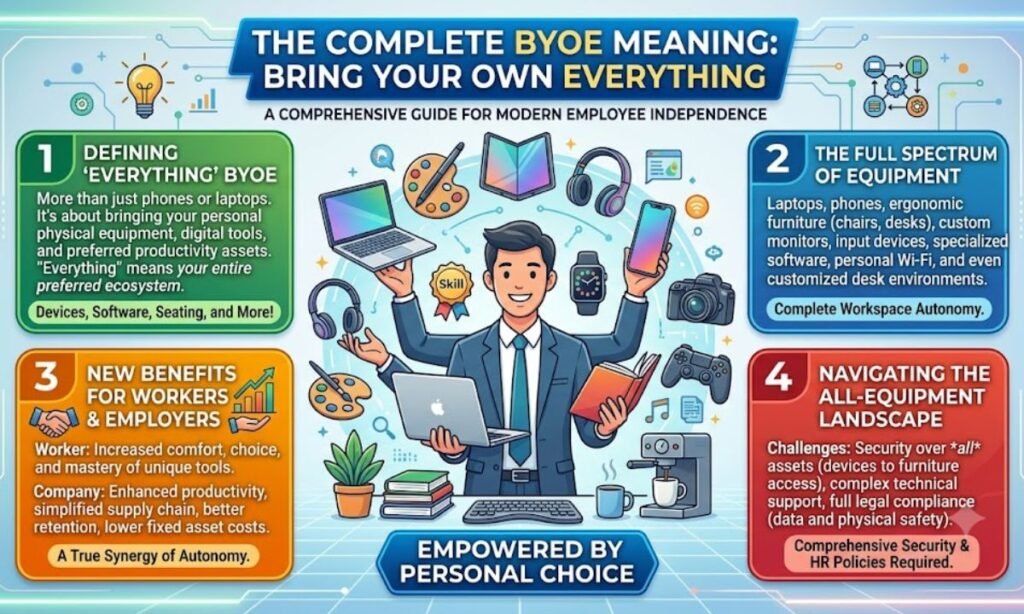
The BYOE meaning is simple: Bring Your Own Everything.
It tells you that the host or organizer isn’t supplying the basics. If an event is labeled BYOE, you’re expected to show up with your own food, drinks, chairs, gear, or whatever else you’ll need.
Unlike vague slang, the BYOE meaning is pretty literal. There’s no hidden joke buried inside it. It’s a heads-up, plain and simple.
Is BYOE an Acronym, Abbreviation, or Slang Word?
Technically, BYOE is an acronym because each letter stands for a word: Bring Your Own Everything.
But in daily use, people treat the BYOE meaning more like internet slang. It sits between formal abbreviation and casual texting shorthand. You won’t find it in a dictionary, yet almost everyone in a group chat understands it instantly.
So the honest answer is: BYOE is an acronym that behaves like slang.
Why People Get Confused About BYOE
Confusion around the BYOE meaning usually comes from three places:
- People mix it up with BYOB (Bring Your Own Bottle/Booze), which only covers drinks.
- Some assume BYOE is only about alcohol or parties, when it actually covers any item.
- Newer users don’t recognize the acronym at all and have to ask.
Because the “E” stands for “Everything,” the BYOE meaning is broader than most similar terms. That broadness is exactly what trips people up.
Different Contexts Where BYOE Appears
The BYOE meaning shifts slightly depending on where you see it. Here’s how it plays out across different settings.
Events and Parties
This is the most common use. A host texts “party tonight, BYOE” to mean guests need to bring drinks, snacks, and sometimes even cups or seating.
Camping and Outdoor Activities
Outdoors, the BYOE meaning often expands to gear: tents, sleeping bags, flashlights, and food. Nobody is packing supplies for you.
Gaming Communities
In gaming groups, BYOE can mean bringing your own equipment, controllers, or even snacks for an in-person LAN party. It’s practical shorthand for “come prepared.”
Workplace Gatherings
At informal office events, BYOE might mean employees bring their own lunch, laptop, or supplies instead of the company covering it.
BYOE meaning in chat
In texting, the BYOE meaning stays consistent: come prepared, don’t expect anything provided. But chat use tends to be shorter and more casual than formal invites.
A typical chat message might read: “we doing the beach thing sat, BYOE btw.” No punctuation, no explanation — the sender assumes you already know the BYOE meaning.
In group chats, BYOE often shows up right after event details, almost like a footnote. Instead of typing out “please bring your own food, drinks, and chairs,” people just type BYOE and move on.
BYOE Platform Breakdown
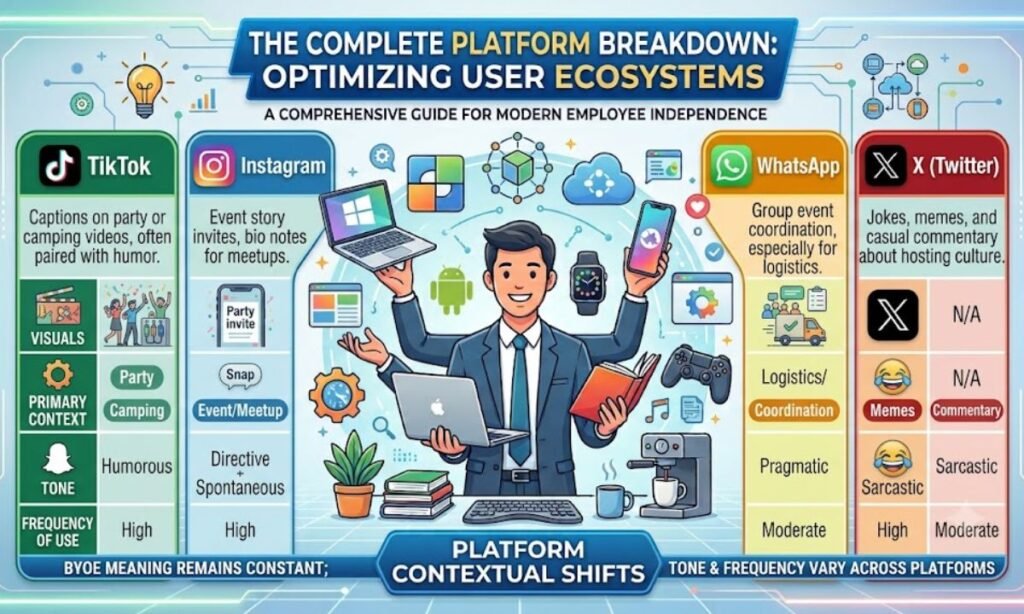
The BYOE meaning doesn’t change across platforms, but the tone and frequency of use do.
| Platform | How BYOE Is Typically Used |
| TikTok | Captions on party or camping videos, often paired with humor |
| Event story invites, bio notes for meetups | |
| Snapchat | Quick texts confirming plans with friends |
| Group event coordination, especially for logistics | |
| X (Twitter) | Jokes, memes, and casual commentary about hosting culture |
TikTok
On TikTok, the BYOE meaning often appears in captions for party recap videos or outdoor adventure clips. Creators use it to explain why nobody’s phone died — because everyone brought their own charger.
Instagram uses BYOE mostly in Story invites and event posts. It’s a quick way to set expectations before people show up.
Snapchat
Snapchat conversations use the BYOE meaning in short bursts, usually between close friends finalizing plans for the night.
WhatsApp group chats, especially family or friend groups planning trips, use BYOE for logistics. It avoids long explanations about who’s bringing what.
X (Twitter)
On X, BYOE sometimes turns into a joke about broke hosting culture — a lighthearted jab at parties where nothing is provided.
Tone & Context Variations
The BYOE meaning stays the same, but tone changes how it lands.
Funny Tone
“Party’s BYOE because I have $4 in my account.” Here, BYOE becomes a punchline about tight budgets.
Sarcastic Tone
“Oh it’s BYOE? Shocking, considering last time too.” This tone pokes fun at a host’s habit of never providing anything.
Playful Tone
“BYOE weekend, let’s see who brings the best snacks.” This version turns BYOE into a friendly challenge.
Serious Tone
“Reminder: cookout is BYOE, no exceptions.” Here, the BYOE meaning is used strictly for logistics, no jokes attached.
Real Chat Examples
Here are fifteen quick examples showing how the BYOE meaning plays out in real conversations.
Example 1
“Bonfire Friday, BYOE. Bring chairs too.”
Example 2
“It’s BYOE so don’t expect me to feed you lol.”
Example 3
“We’re camping next weekend — BYOE, obviously.”
Example 4
“Office potluck is BYOE this year, budget cuts.”
Example 5
“BYOE rave tonight, bring your own energy drinks.”
Example 6
“Why is every party you host BYOE 😭”
Example 7
“Beach day is BYOE — towels, food, everything.”
Example 8
“LAN party this weekend, BYOE for controllers.”
Example 9
“It’s a BYOE cookout, grill’s the only thing I’m providing.”
Example 10
“Road trip snacks are BYOE, pack your own bag.”
Example 11
“BYOE tailgate, don’t forget chairs and coolers.”
Example 12
“Movie night BYOE, popcorn’s on you this time.”
Example 13
“Studio session is BYOE, bring your own gear.”
Example 14
“Hiking trip Sunday, BYOE water and snacks.”
Example 15
“Game night’s BYOE, we’re out of everything at home.”
Other Meanings of BYOE in Text
While “Bring Your Own Everything” is the dominant BYOE meaning, a few less common variations exist:
- Bring Your Own Enthusiasm — used in motivational or workplace contexts.
- Bring Your Own Entertainment — for gatherings without planned activities.
- Bring Your Own Equipment — common in sports or hobby groups.
These alternate versions of the BYOE meaning are rarer, but they show up occasionally depending on the community.
Grammar & Language Role
Part of Speech
BYOE functions as an adjective or a standalone descriptor. It modifies an event, like “BYOE party” or “BYOE trip.”
Sentence Position
Most commonly, BYOE sits at the end of a sentence as a tag, such as “we’re meeting up, BYOE.” It can also open a sentence: “BYOE tonight, don’t forget.”
Can It Replace a Full Sentence?
Yes. On its own, “BYOE” can stand in for “please bring your own supplies.” The BYOE meaning is compact enough to work as a one-word instruction.
Formal vs Informal Register
BYOE is strictly informal. It belongs in texts, captions, and casual invites — not in professional emails or formal documents, unless the workplace culture is very relaxed.
How to Reply to BYOE
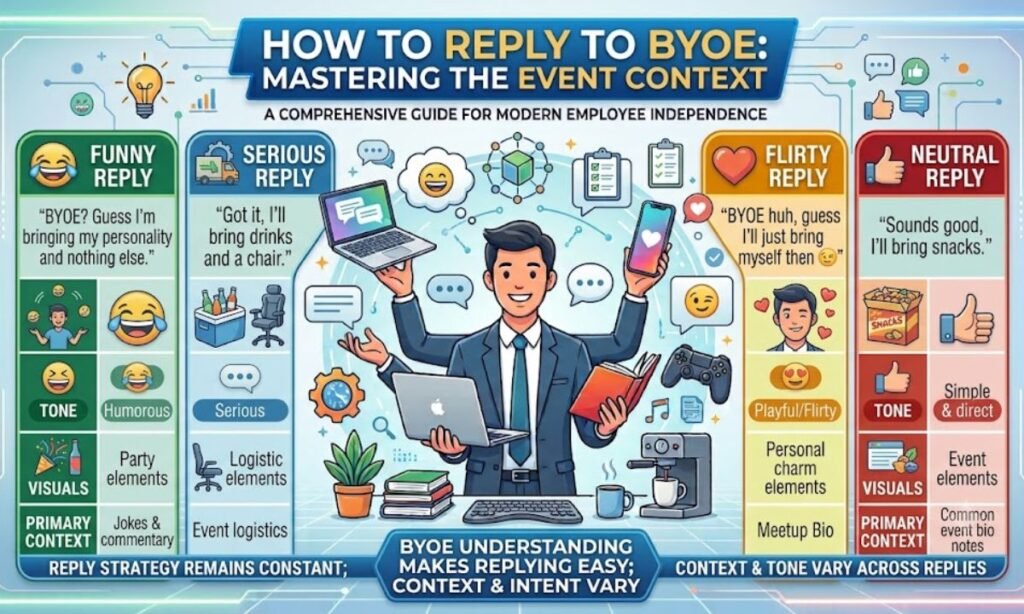
Once you understand the BYOE meaning, replying is easy.
Funny Reply
“BYOE? Guess I’m bringing my personality and nothing else.”
Serious Reply
“Got it, I’ll bring drinks and a chair.”
Flirty Reply
“BYOE huh, guess I’ll just bring myself then 😉”
Neutral Reply
“Sounds good, I’ll bring snacks.”
Similar Slang Words or Alternatives
Several related acronyms share the same spirit as the BYOE meaning:
- BYOB — Bring Your Own Bottle/Booze
- BYOD — Bring Your Own Device
- BYOF — Bring Your Own Food
- BYOL — Bring Your Own Liquor
- BYOG — Bring Your Own Gear
All of these terms follow the same “bring your own” pattern, but BYOE remains the broadest, covering literally everything a guest might need.
Who Uses This Term?
Gen Z
Gen Z uses BYOE frequently in texting and social captions, often blending it with humor about broke hosting or minimal-effort plans.
Millennials
Millennials also use the BYOE meaning, especially for cookouts, camping trips, and casual get-togethers, though slightly less playfully than Gen Z.
Older Adults
Older adults recognize BYOE less often, though many are familiar with BYOB and can guess the BYOE meaning from context.
Regional Usage
BYOE usage isn’t tied to one specific region. It spreads mainly through online culture rather than geography, so it appears similarly across English-speaking countries.
Platform Usage
BYOE shows up most on texting apps and short-form video captions, where quick, casual language is the norm.
Origin & Internet Culture
The BYOE meaning traces back to the older “BYOB” family of party terms. BYOB itself has roots going back decades as shorthand for bringing your own alcohol to gatherings.
As casual event culture grew online, people started stretching the format. Instead of just drinks, hosts began asking guests to bring food, chairs, and other essentials. That shift birthed BYOE — a wider, catch-all version of the original phrase.
Social media accelerated this. Once BYOE started appearing in captions, invites, and group chats, the BYOE meaning solidified as shorthand for “come fully prepared.”
Safety & Appropriateness
Is BYOE Offensive?
No. The BYOE meaning isn’t offensive. It’s a neutral, practical instruction.
Does It Contain Profanity?
No. BYOE contains no profanity or hidden vulgar meaning.
Is It Appropriate for School?
Yes, BYOE is appropriate for school settings, especially for casual events like potlucks or club meetups.
Is It Appropriate for Work?
It depends on the workplace. Casual teams might use BYOE for informal gatherings, but formal communications should spell it out instead.
Cultural Sensitivity Notes
In cultures where hosting guests generously is a strong tradition, the BYOE meaning might come across as less hospitable. Context and audience matter.
When to Use and When Not to Use BYOE
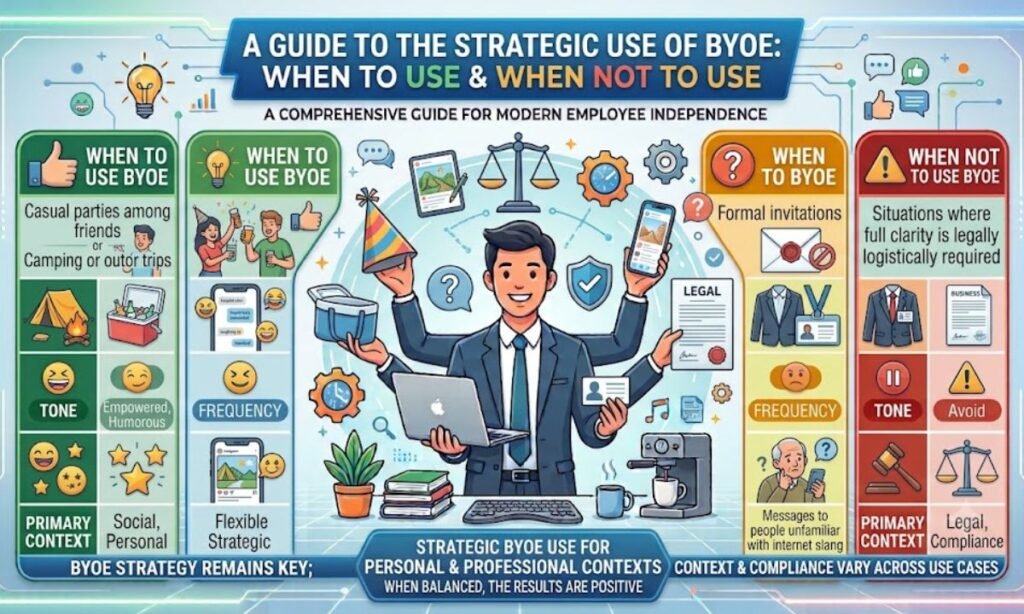
When to Use BYOE
- Casual parties among friends
- Camping or outdoor trips
- Informal group chats
- Social media captions for laid-back events
When Not to Use BYOE
- Formal invitations
- Professional business communication
- Situations where full clarity is legally or logistically required
- Messages to people unfamiliar with internet slang
Real-World Observation
In practice, the BYOE meaning has become a quiet standard for casual event planning. Instead of typing a full paragraph explaining what’s provided and what isn’t, people default to three letters. It saves time, sets clear expectations, and fits naturally into the fast pace of modern texting.
What’s interesting is how flexible the term has become. The core BYOE meaning stays fixed — bring your own everything — but the tone around it constantly shifts, from sarcastic to sincere depending on who’s sending it.
Frequently Asked Questions
What does BYOE mean in texting?
It means “Bring Your Own Everything,” a signal that nothing will be provided.
Is BYOE the same as BYOB?
No. BYOB only covers drinks, while the BYOE meaning covers all supplies.
Is BYOE rude?
Not inherently. It’s practical, though some may see it as less hospitable.
Can BYOE be used at work?
Yes, but only in casual, informal workplace settings.
Where did BYOE come from?
It evolved from the older BYOB acronym as event culture expanded online.
Does BYOE only apply to parties?
No, it also applies to camping, gaming, and workplace gatherings.
Is BYOE used worldwide?
Yes, it spreads mostly through online culture rather than a specific region.
Conclusion
The BYOE meaning boils down to one simple idea: come prepared, because nothing is being handed to you. Whether it shows up in a party invite, a camping group chat, or a gaming server, the BYOE meaning stays consistent across every platform and context.
Now that you understand the full BYOE meaning — from its origin in BYOB culture to how it’s used in real chats — you’ll never have to second-guess that three-letter acronym again. Next time someone texts “BYOE,” you’ll know exactly what to pack.
