

Scrolling through a group chat and someone drops “TBF” out of nowhere? You’re not missing some inside joke — it’s one of the most common pieces of texting shorthand out there, and once you know it, you’ll start noticing it everywhere. 📱
What Does TBF Mean in Text Messages? 🤔
TBF stands for “to be fair.” People type it when they want to add a balanced, honest, or slightly more understanding take to something — usually right before pointing out a detail that makes a situation seem less one-sided.
Simple Definition
If someone texts “TBF, he did apologize,” they’re saying: I get why you’re annoyed, but let’s be fair — there’s another side to this. It’s a small phrase that does a lot of conversational work: it softens opinions, adds nuance, and shows the person is thinking things through rather than just reacting.
Quick Answer: TBF means “to be fair.” It’s used in texts and on social media to introduce a more balanced or reasonable point of view, often right before defending someone, softening criticism, or admitting there’s another side worth considering.
Why Is TBF So Popular in Texting and Social Media? 💬
Texting moves fast, and tone is easy to lose in a wall of short messages. TBF fills a gap — it lets someone flag “I’m about to be reasonable here” without writing a whole paragraph explaining themselves.
A few reasons it caught on so widely:
- It’s short. Three letters instead of three words saves time without losing meaning.
- It signals intent. Typing TBF tells the reader your next sentence is meant to balance the conversation, not start a fight.
- It fits casual platforms. Group chats, Reddit threads, Discord servers, and comment sections all reward quick, low-effort ways to sound thoughtful.
The phrase “to be fair” has been part of everyday English for a long time. It just got shortened once online chatrooms and forums needed faster ways to type common phrases, and the abbreviation stuck around as texting and social apps took over.
How TBF Is Commonly Used in Text Messages 📲
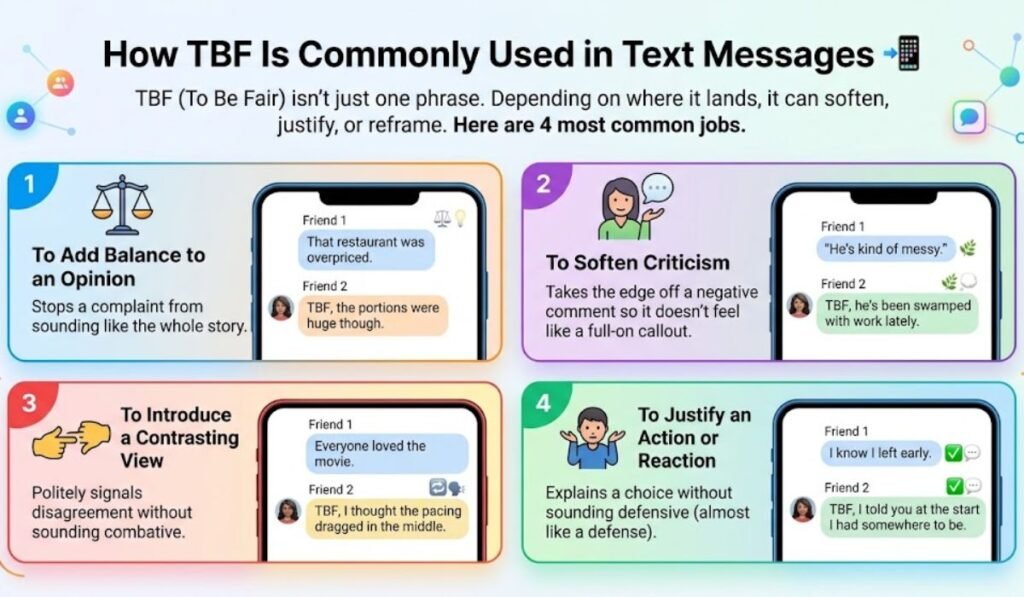
TBF isn’t a one-note phrase. Depending on where it lands in a sentence, it can soften, justify, or reframe. Here are the four most common jobs it does.
1. To Add Balance to an Opinion
“That restaurant was overpriced. TBF, the portions were huge though.”
Here, TBF stops the complaint from sounding like the whole story.
2. To Soften Criticism
“He’s kind of messy. TBF, he’s been swamped with work lately.”
This version takes the edge off a negative comment so it doesn’t feel like a full-on callout.
3. To Introduce a Contrasting View
“Everyone loved the movie. TBF, I thought the pacing dragged in the middle.”
Used this way, TBF politely signals disagreement without sounding combative.
4. To Justify an Action or Reaction
“I know I left early. TBF, I told you at the start I had somewhere to be.”
Here it’s used almost like a defense — a way to explain a choice without sounding defensive.
TBF Meaning in Social Media 🌐
On platforms like X (Twitter), Reddit, and Instagram comments, TBF shows up constantly in debates, replies, and quote-tweets. It works the same way it does in texting, just with a bigger audience watching.
A common pattern on Reddit and X: someone posts a hot take, and a reply starts with “TBF…” before offering a counterpoint. It’s become a kind of internet shorthand for “I hear you, but consider this” — a way to disagree without escalating.
TBF Meaning Urban Dictionary 📖
Urban Dictionary’s earliest entries for TBF define it simply as “to be fair,” and that definition has stayed remarkably consistent since it first appeared there in the mid-2000s. Some joke entries exist too — like using TBF to mean “too bad for” in playful trash talk — but these are rare and mostly used ironically rather than as a genuine alternative meaning.
TBF Meaning in Football ⚽
Sports fans, especially soccer commentators and fans on forums, use TBF the same way as everywhere else: “to be fair.” You’ll often see it in match reactions like “Well played, they deserved that win TBF” — acknowledging a result even when it stings a little.
There’s a separate, unrelated use in baseball statistics, where TBF stands for “Total Batters Faced,” a pitching metric. It’s worth knowing this exists so you don’t confuse a sports-stats table with someone just being fair-minded in a comment section.
TBF Meaning in Business 💼
In workplace chats or informal internal messages, TBF still means “to be fair” — but it’s used more cautiously. Someone might type “TBF, the deadline was unrealistic from the start” in a Slack message to a close coworker, but it rarely appears in formal emails, client communication, or official documents.
There’s also a completely different finance term, TBTF, meaning “too big to fail,” used to describe major institutions whose collapse would be catastrophic. It’s easy to mix these up because they look similar, but they have nothing to do with each other.
Tone and Emotional Context of TBF 🎭
TBF carries a specific emotional flavor: thoughtful, a little diplomatic, and generally non-confrontational. It rarely sounds angry on its own.
Common Tones Associated with TBF
- Reasonable and even-handed
- Slightly apologetic when softening criticism
- Casual and conversational
- Mildly persuasive, when used to argue a point
Not Usually Used For
- Genuine anger or hostility
- Formal apologies
- Serious, high-stakes conversations (breakups, conflict resolution, legal matters)
Because it’s such a light, easygoing phrase, using TBF in a heavy emotional moment can come across as dismissive rather than fair — more on that below.
Examples of TBF in Real-Life Text Conversations 💌
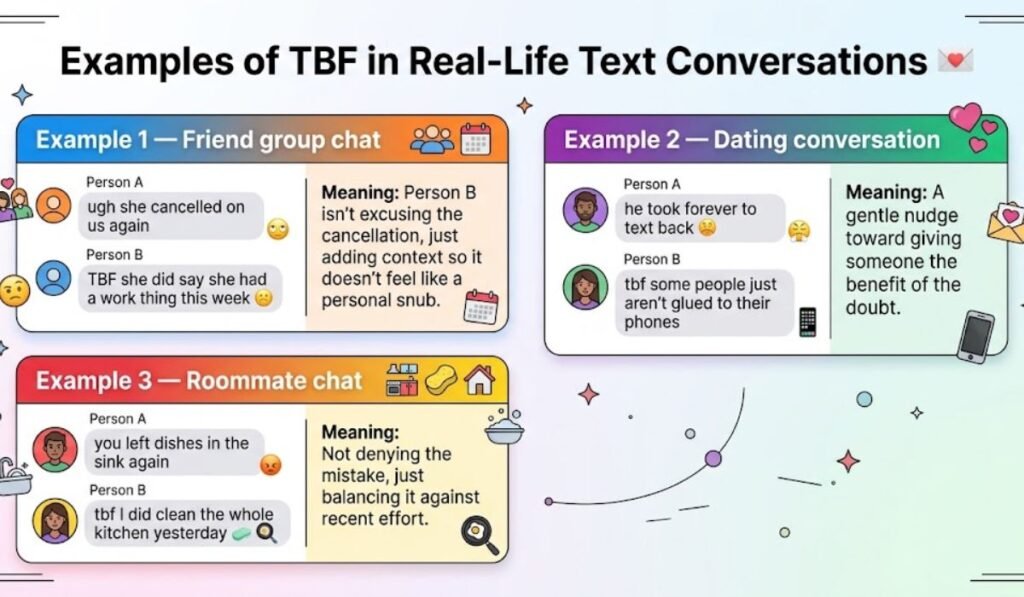
Example 1 — Friend group chat
Person A: ugh she cancelled on us again
Person B: TBF she did say she had a work thing this week
Meaning: Person B isn’t excusing the cancellation, just adding context so it doesn’t feel like a personal snub.
Example 2 — Dating conversation
Person A: he took forever to text back
Person B: tbf some people just aren’t glued to their phones
Meaning: A gentle nudge toward giving someone the benefit of the doubt.
Example 3 — Roommate chat
Person A: you left dishes in the sink again
Person B: tbf I did clean the whole kitchen yesterday
Meaning: Not denying the mistake, just balancing it against recent effort.
Is TBF Formal or Informal? ✍️
TBF is firmly informal. It belongs in texts, DMs, casual Slack messages, and social media comments — not in emails to clients, cover letters, or official reports. If the setting calls for polish, spell it out as “to be fair” instead of abbreviating it.
TBF vs TBH: What’s the Difference? 🔍
These two get mixed up constantly because they often show up in similar spots in a sentence, but they carry slightly different intentions.
| Term | Stands For | Main Purpose | Typical Vibe |
| TBF | To Be Fair | Add balance or another perspective | Diplomatic, considerate |
| TBH | To Be Honest | State your genuine, sometimes blunt opinion | Direct, sometimes unfiltered |
Example Comparison
- “TBH, I didn’t like the movie.” (Just stating an honest opinion.)
- “TBF, the movie had a slow start, but it picked up.” (Acknowledging both good and bad.)
TBH leans toward raw honesty, even if it stings a little. TBF leans toward fairness, even if it means defending someone you don’t fully agree with.
Common Misunderstandings About TBF ⚠️
1. TBF Is Not Always Defensive
People sometimes assume TBF means someone’s making excuses. In reality, it’s often used to add nuance to someone else’s situation, not just to justify your own actions.
2. TBF Is Not Sarcastic by Default
Written text lacks tone, so TBF can look sarcastic out of context. Most of the time, though, it’s sincere — the sarcasm (if any) comes from surrounding words, not the abbreviation itself.
3. TBF Doesn’t Mean Agreement
Saying TBF doesn’t mean the person fully agrees with what came before. It usually just means they’re willing to acknowledge a valid point while still holding their own opinion.
When NOT to Use TBF in Text Messages 🚫
- During a serious argument — it can sound like you’re minimizing someone’s feelings.
- In professional emails — it reads as too casual for formal settings.
- Right after someone shares bad news — leading with fairness before empathy can feel cold.
- When someone needs to vent, not debate — TBF invites counterpoints, which isn’t always what a person wants in the moment.
Alternatives to TBF in Text Messages 🔄
Casual Alternatives
- “Ngl” (not gonna lie)
- “Then again…”
- “On the flip side…”
- “I mean, tbh…”
Softer Phrases
- “To be honest, though…”
- “I get where you’re coming from, but…”
- “That said…”
- “In their defense…”
These work well when TBF feels too abrupt or when you want a slightly gentler way to introduce a different angle.
TBF in Social Media and Online Culture 📱✨
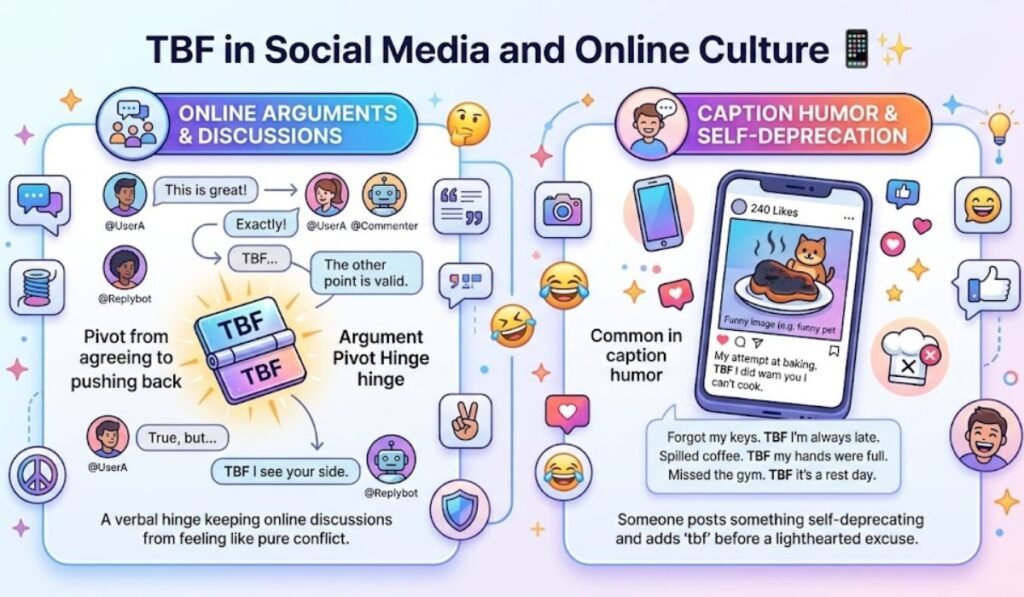
Beyond individual chats, TBF has become part of how online arguments are structured. In comment sections and quote-posts, it often marks the moment someone pivots from agreeing to gently pushing back — a small verbal hinge that keeps online discussions from feeling like pure conflict.
It’s also common in caption humor, where someone posts something self-deprecating and adds “tbf” before a lighthearted excuse, like “tbf I did warn you I can’t cook.”
Why Understanding TBF Matters 🧩
Getting slang like TBF right isn’t just about sounding current — it’s about reading tone accurately. Misreading TBF as sarcastic or dismissive can cause unnecessary friction in a conversation that was actually meant to be considerate. Understanding the phrase helps you both use it well and respond to it appropriately when someone else sends it your way.
Is TBF Rude or Friendly? 🙂
On its own, TBF is friendly and even-handed, not rude. It becomes uncomfortable only when it’s used to dismiss someone’s feelings or to argue a point at the wrong moment. Context — and what comes after TBF — matters more than the abbreviation itself.
Frequently Asked Questions About TBF Meaning in Text 📋
What does TBF mean in a text from a guy or girl?
It means the same thing regardless of who sends it: “to be fair.” It’s typically used to add a balanced perspective or soften an opinion, not a flirty or gendered signal on its own.
Is TBF the same as TBH?
No. TBF means “to be fair” and introduces balance, while TBH means “to be honest” and introduces a direct, sometimes blunt opinion. They often appear in similar spots but carry different intentions.
Can TBF be used in professional messages?
It’s best avoided in formal emails or client communication. If the setting is formal, write out “to be fair” instead of abbreviating it.
Does TBF mean someone is disagreeing with you?
Not necessarily. It usually means they’re adding another angle to the conversation, which can support, soften, or gently challenge what was said before.
What does TBF mean on Snapchat or Instagram?
Same meaning as everywhere else — “to be fair” — just used in captions, comments, or DMs on those platforms.
Is TBF always used sarcastically?
No. Most uses are sincere. Any sarcasm usually comes from the rest of the sentence rather than the abbreviation itself.
What’s the difference between TBF and TBTF?
TBF means “to be fair” and is used in casual conversation. TBTF means “too big to fail,” a completely unrelated finance term describing institutions whose failure would cause major economic damage.
Why do people use TBF instead of just saying it fully?
Mostly for speed and casual tone. Typing three letters feels quicker and more natural in fast-paced chats than spelling out “to be fair” every time.
Conclusion
TBF is a small phrase that carries a big conversational job: it lets people add fairness, nuance, and a second perspective without sounding preachy or long-winded. Once you can spot when it’s softening criticism, defending someone, or just adding balance, texts and comment threads that use it start to read a lot more clearly — and you’ll probably find yourself reaching for it too. 🙌
