
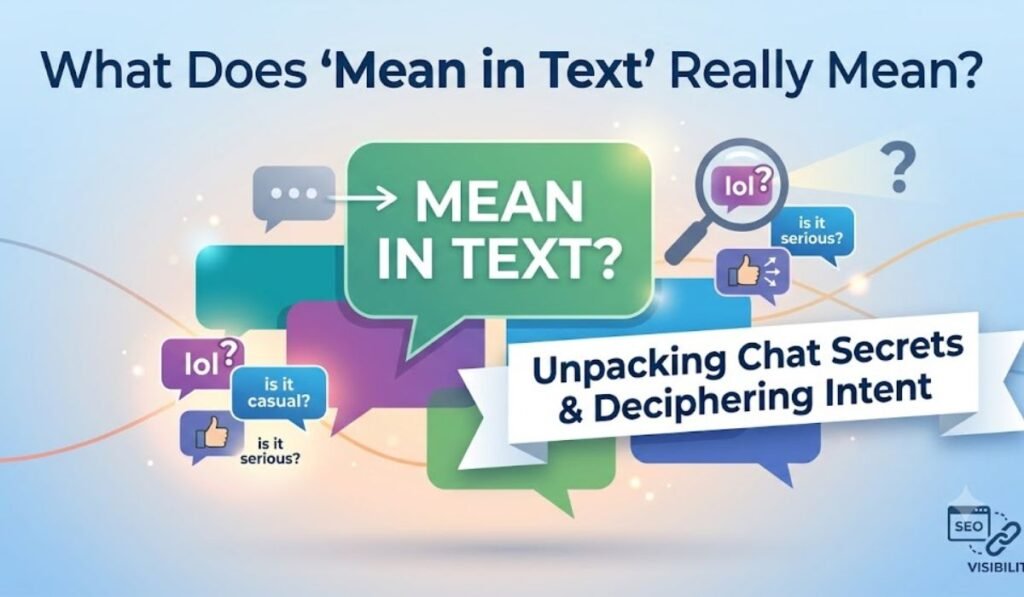
You get a text. It’s short. Maybe it’s just “k.” Or “fine.” Or “haha.” And suddenly you’re staring at your phone, wondering what does “mean in text” really mean this time. If you’ve ever reread a message three times trying to catch its real tone, you already understand why this question matters so much in 2026.
This guide breaks down what “mean in text” really means, how it shows up in everyday messaging, and why the same words can carry completely different weight depending on who sends them.
What Does “Mean in Text” Actually Refer To?
When people ask what does “mean in text” really mean, they’re rarely asking for a dictionary definition. They’re asking about intent. They want to know what the sender was actually feeling when they typed those words.
A Meaning Beyond Dictionary Words
Text messages strip away tone of voice. They strip away facial expressions. What’s left is just letters on a screen. So the real meaning in text often lives outside the words themselves.
A single “ok” can mean:
- Genuine agreement
- Mild annoyance
- Complete disinterest
- “I don’t want to argue right now”
That’s the core of what “mean in text” really means. It’s not about vocabulary. It’s about reading between the lines.
Why It Matters So Much
Misreading a text can spark a fight. It can end a friendship. It can also save one, if you catch the real meaning early. Understanding what “mean in text” really means helps you avoid unnecessary drama and respond the right way.
How Text Meaning Looks on the Screen
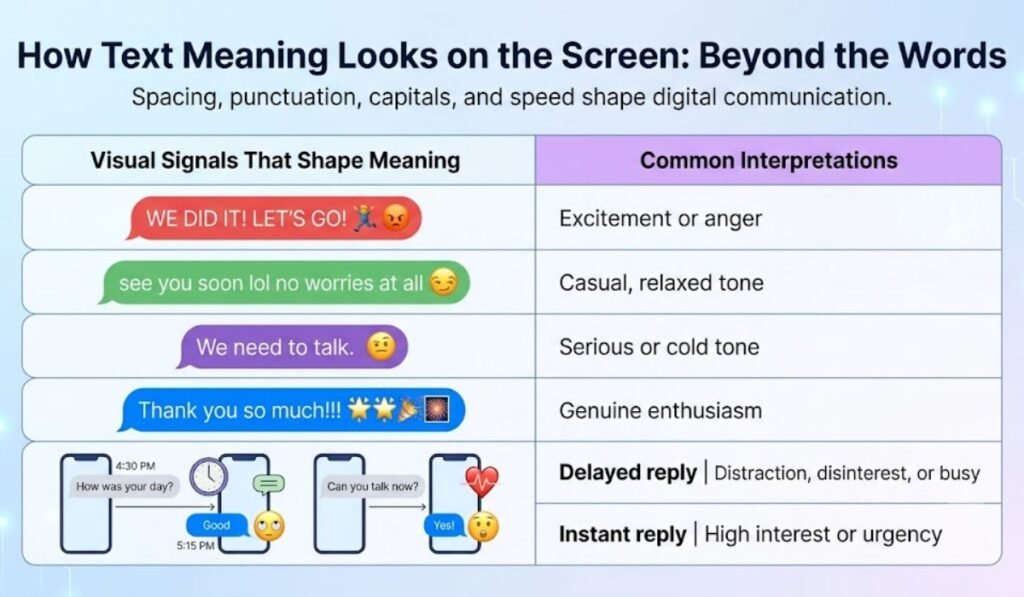
Screens communicate more than words. Spacing, punctuation, capital letters, and even response speed all shape meaning.
Visual Signals That Shape Meaning
Here’s what commonly changes how a message reads:
| Signal | Common Interpretation |
| ALL CAPS | Excitement or anger |
| No punctuation | Casual, relaxed tone |
| Period at the end | Serious or cold tone |
| Multiple exclamation marks | Genuine enthusiasm |
| Delayed reply | Distraction, disinterest, or busy |
| Instant reply | High interest or urgency |
Why Format Feels Emotional
Humans are wired to read emotion into everything, even punctuation. That’s why understanding what “mean in text” really means includes paying attention to format, not just content.
Mean in text really mean urban dictionary
Urban Dictionary is often the first stop for people trying to figure out slang. But it only tells part of the story. Urban Dictionary gives you a static definition. It doesn’t tell you how a word feels when your crush sends it at 1 a.m. versus your coworker sending it at 9 a.m.
So when people search “mean in text really mean urban dictionary,” they’re usually hoping for something deeper than a crowd-sourced definition. They want context. Urban Dictionary can explain what a slang term technically means. It can’t explain what “mean in text” really means in your specific conversation, with your specific person, in your specific mood.
Mean in text really mean from a girl
This is one of the most searched versions of this topic, and for good reason. The sender changes everything.
When a girl texts “haha,” it often signals mild amusement, not full engagement. “Hahaha” usually means she found something genuinely funny. “LOL” by itself can mean she’s just acknowledging the message without much emotion behind it.
These aren’t universal rules. But they’re patterns that show up again and again. If you’re trying to figure out what “mean in text” really means from a girl specifically, look at:
- Response time
- Message length
- Use of emojis
- Whether she asks follow-up questions
Short, flat replies usually mean lower interest. Longer, detailed replies usually mean the opposite.
The Historical Roots of Reading Hidden Meaning
Reading between the lines isn’t new. Humans have always tried to decode meaning beyond spoken or written words.
Before Smartphones
Letters, telegrams, and even early emails carried hidden meaning too. A short letter often signaled distance. A long one signaled care. People have always searched for what “mean in text” really means, even before texting existed.
Ancient Communication Patterns
Ancient cultures relied on tone, gesture, and symbolism to communicate feelings that words alone couldn’t capture. Texting is just the newest chapter of an old human habit: trying to find meaning where none is explicitly stated.
Examples of “Mean in Text”
Let’s look at real examples to understand what “mean in text” really means in practice.
Example 1
Message: “Sure.” Real meaning: Often passive-aggressive or reluctant agreement, especially with a period at the end.
Example 2
Message: “haha yeah” Real meaning: Polite acknowledgment, but not necessarily genuine excitement.
Example 3
Message: “Can we talk?” Real meaning: Usually signals something serious is coming, not casual chat.
Example 4
Message: “No worries!” Real meaning: Can be genuine reassurance, or a polite way to mask frustration.
Example 5
Message: “…” (just dots) Real meaning: Hesitation, thinking, or discomfort with what was just said.
Each of these shows what “mean in text” really means in real life. The words are simple. The emotional weight behind them isn’t.
How American Texting Culture Shaped Modern Meaning
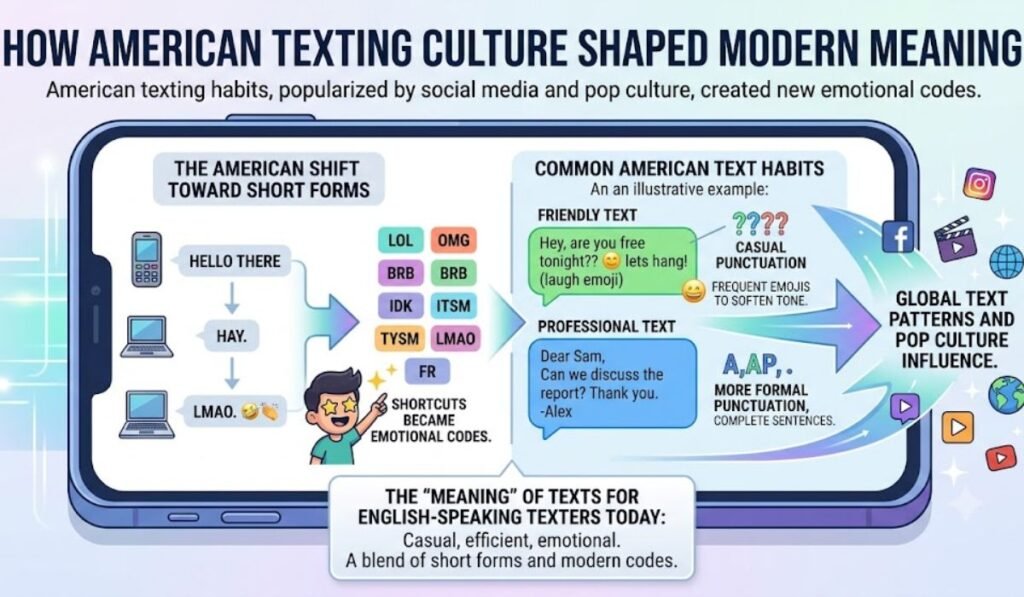
Texting habits differ across the world, but American texting culture has heavily shaped global patterns, especially through social media and pop culture.
The American Shift Toward Short Forms
American texters popularized abbreviations like “lol,” “brb,” and “omg.” These shortcuts didn’t just save time. They created entirely new emotional codes.
Common American Text Habits
- Frequent use of emojis to soften tone
- Heavy reliance on abbreviations
- Casual punctuation in friendly texts
- More formal punctuation in professional texts
These habits directly influence what “mean in text” really means for most English-speaking texters today.
Why Context Matters More Than Words
You can’t understand what “mean in text” really means without context. The same sentence can mean two completely different things depending on the situation.
Context Changes Everything
Relationship history, time of day, ongoing conversation topics, and even recent events all shape how a message should be read.
A Small Example
If someone texts “fine” after a disagreement, it likely means they’re upset. If they text “fine” while planning dinner, it probably just means agreement. Same word. Different meaning entirely.
Emotional and Psychological Meaning in Texts
Our brains naturally search for emotional cues, even in flat text.
Why the Brain Fills the Gaps
Humans crave tone and emotion. Since text lacks both, our minds fill in the blanks based on past experiences, mood, and assumptions. This is a huge part of what “mean in text” really means on a psychological level.
Common Emotional Associations
- Short replies often feel like rejection
- Long replies often feel like reassurance
- Silence often feels like anger, even when it’s just busyness
- Fast replies often feel like eagerness
Common Text Meanings in the USA
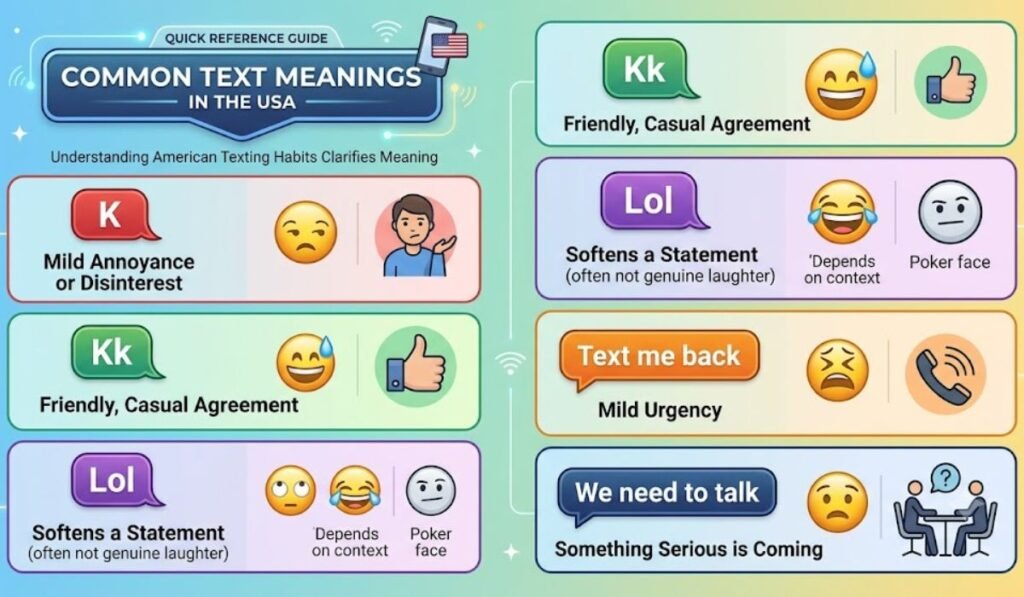
Understanding regional texting habits helps clarify what “mean in text” really means for American audiences.
Quick Reference Table
| Phrase | Common US Meaning |
| “K” | Mild annoyance or disinterest |
| “Kk” | Friendly, casual agreement |
| “Lol” | Softens a statement, not always genuine laughter |
| “Text me back” | Mild urgency |
| “We need to talk” | Something serious is coming |
What Americans Often Notice First
Americans tend to focus heavily on punctuation and capitalization first, then move to word choice and response timing.
Generational Differences in Reading Text Tone
Not everyone reads text the same way. Age plays a huge role in what “mean in text” really means to different people.
Younger Users
Gen Z texters often see punctuation as tone-heavy. A period can feel cold or final. Lowercase texting feels more casual and friendly.
Older Users
Older generations often use full punctuation without meaning anything negative by it. They may not realize a period feels harsh to younger texters.
Common Generational Gaps
- Older users: proper grammar equals respect
- Younger users: proper grammar can equal distance
- Older users: fewer emojis
- Younger users: emojis as tone markers
Social Media and Modern Internet Usage
Texting habits don’t exist in isolation. Social media constantly reshapes what “mean in text” really means.
Platform Culture Matters
Each platform has its own texting personality. DMs on Instagram feel different from iMessage. Snapchat feels more casual than email-style texting apps.
Where Meaning Evolves Fast
New slang, abbreviations, and emoji meanings spread quickly through platforms like TikTok, then bleed into everyday texting. This constant evolution is part of what “mean in text” really means today compared to even five years ago.
Cross-Cultural and Spiritual Views of Meaning
Understanding what “mean in text” really means also has cultural and even philosophical layers.
Cross-Cultural Communication
Different cultures interpret directness differently. Some cultures view short texts as efficient. Others view them as rude. This affects how “mean in text” really means shifts across borders.
A Broader Human Pattern
Across cultures and history, humans have always searched for meaning beneath the surface of communication. Texting is simply today’s version of that timeless pattern.
Misunderstandings, Misuse, and Controversies
Not every interpretation is accurate. Misreading tone is extremely common.
Common Misreadings
- Assuming silence always means anger
- Assuming short replies always mean disinterest
- Assuming punctuation always signals a negative tone
When Meaning Becomes Controversial
Sometimes people weaponize texting norms, deliberately using cold punctuation to upset someone, or claiming misunderstanding after sending something hurtful. This is where knowing what “mean in text” really means becomes genuinely useful, not just curious trivia.
How Meaning Has Shifted Over Time
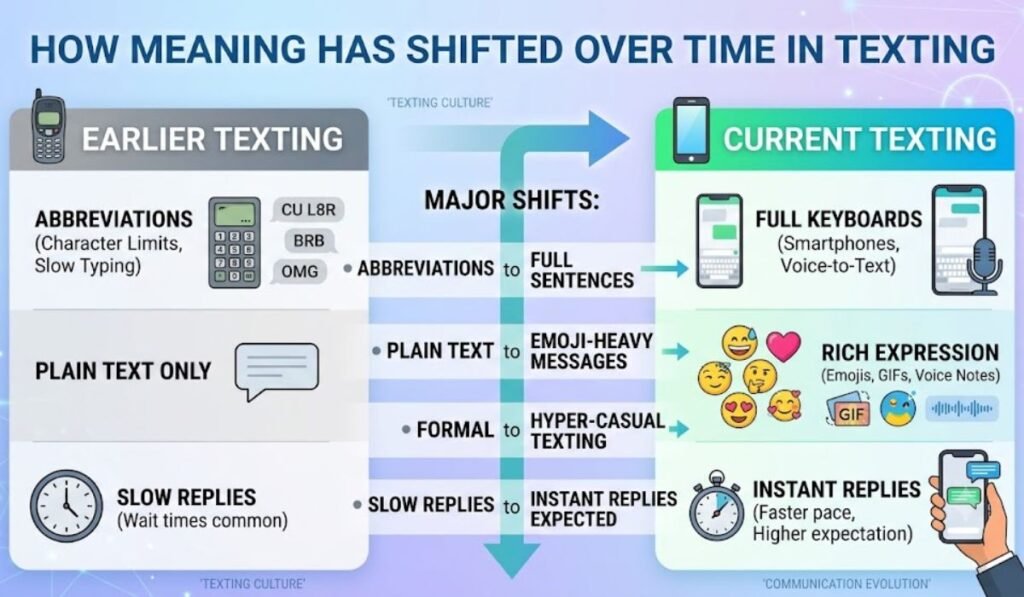
Texting language constantly evolves, and so does what “mean in text” really means.
Earlier Texting
Early texting relied heavily on abbreviations due to character limits and slow typing on number pads.
Current Texting
Modern texting uses full keyboards, emojis, GIFs, and voice-to-text, allowing richer emotional expression, but also more room for misinterpretation.
Major Shifts
- From abbreviations to full sentences
- From plain text to emoji-heavy messages
- From formal texting to hyper-casual texting
- From slow replies being normal to instant replies being expected
Frequently Asked Questions
What does “mean in text” really mean?
It refers to the true emotional intent behind a text message, beyond just the literal words used.
Why does punctuation change meaning in texting?
Because texting lacks tone of voice, punctuation like periods or exclamation marks becomes a stand-in for emotional cues.
Does “mean in text” really mean the same thing from everyone?
No. It varies by sender, relationship, generation, and even platform.
How can I avoid misreading texts?
Consider context, relationship history, and recent conversations before assuming a message’s tone.
Is Urban Dictionary reliable for texting meanings?
It’s useful for slang definitions, but it can’t capture personal or situational tone.
Conclusion
So, what does “mean in text” really mean? It’s not just about words. It’s about tone, timing, punctuation, sender, and context all working together.
Texting has become its own language. Understanding what “mean in text” really means helps you avoid misunderstandings, read people more accurately, and communicate with more confidence.
The next time a message leaves you confused, pause. Look past the words. Ask yourself what “mean in text” really means in that specific moment, with that specific person. That’s usually where the real answer is hiding.
