
If you’ve seen “idm” pop up in a text and paused mid-scroll wondering what it means, you’re not alone. It’s short, it’s casual, and it shows up everywhere from group chats to Instagram comments — but its brevity is exactly why it trips people up. 🤔
💬 What Does IDM Mean in Text?
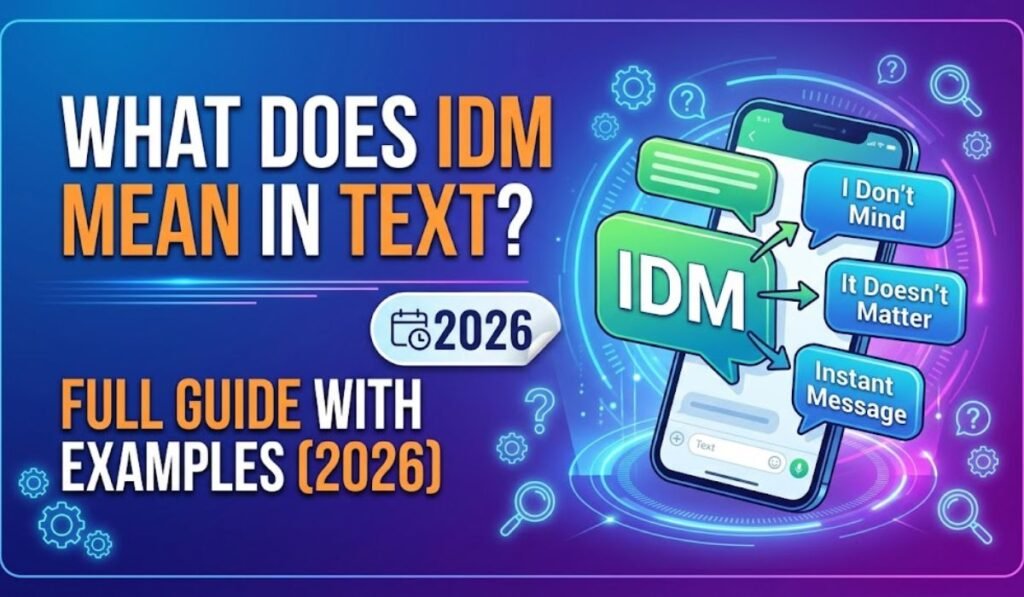
Quick Answer: IDM stands for “I Don’t Mind.” People use it to show they’re okay with a choice, plan, or suggestion without a strong opinion either way. It’s casual, low-effort, and common in texts, DMs, and group chats among friends.
Simple Definition
At its core, IDM is a texting shorthand for “I don’t mind.” It shows agreement or flexibility, and it’s the meaning most people intend when they type it in a casual chat. Someone sends it when they genuinely have no preference and are happy to go along with whatever the other person decides.
It’s not a complicated term. There’s no hidden code to crack — it’s simply a fast way to say “either option works for me” without typing the whole sentence out.
Tone and Intent
The tricky part isn’t the definition — it’s the tone. IDM can read as relaxed and easygoing in one conversation and slightly flat in another. A lot depends on punctuation, capitalization, and what came before it.
“idm 😊” after a fun suggestion feels warm. A bare “idm.” dropped into a serious conversation can feel distant, even if that’s not what the sender meant. Context does most of the heavy lifting here, not the letters themselves.
📱 Why Is IDM Popular in Texting?
Texting rewards speed. Typing “I don’t mind” takes a few extra seconds compared to four letters, and when you’re juggling multiple conversations at once, those seconds add up. IDM lets people respond quickly without sounding like they’re ignoring the question.
It’s also genuinely useful in group settings. When five people are trying to agree on a restaurant or a movie time, “idm” is a fast way to signal you’re not the holdout — you’re fine with the group decision. That makes planning smoother, which is probably why the abbreviation has stuck around instead of fading out like some slang does.
There’s also a generational comfort factor. Younger texters grew up shortening everything — from “u” for “you” to “rn” for “right now” — so an abbreviation like IDM fits naturally into how they already communicate rather than feeling like a new trend to learn.
🗣️ How IDM Is Used in Everyday Conversations
IDM almost always shows up as a response, not something someone brings up out of nowhere. It answers a question, reacts to a suggestion, or closes out a small decision.
Casual Examples
Example 1
Person A: “Pizza or tacos tonight?”
Person B: “idm, you pick”
Meaning: Either choice works; B is leaving the final call to A.
Example 2
Person A: “Can we push our call to 4 instead of 3?”
Person B: “idm”
Meaning: The time change is fine, no objection.
Example 3
Person A: “Want to split the bill or should I just cover it?”
Person B: “idm splitting it”
Meaning: B is comfortable with splitting the cost.
In each case, the responder isn’t excited or unexcited — they’re just flexible. That’s the whole function of IDM: removing friction from small, everyday decisions.
📲 IDM Meaning in Social Media
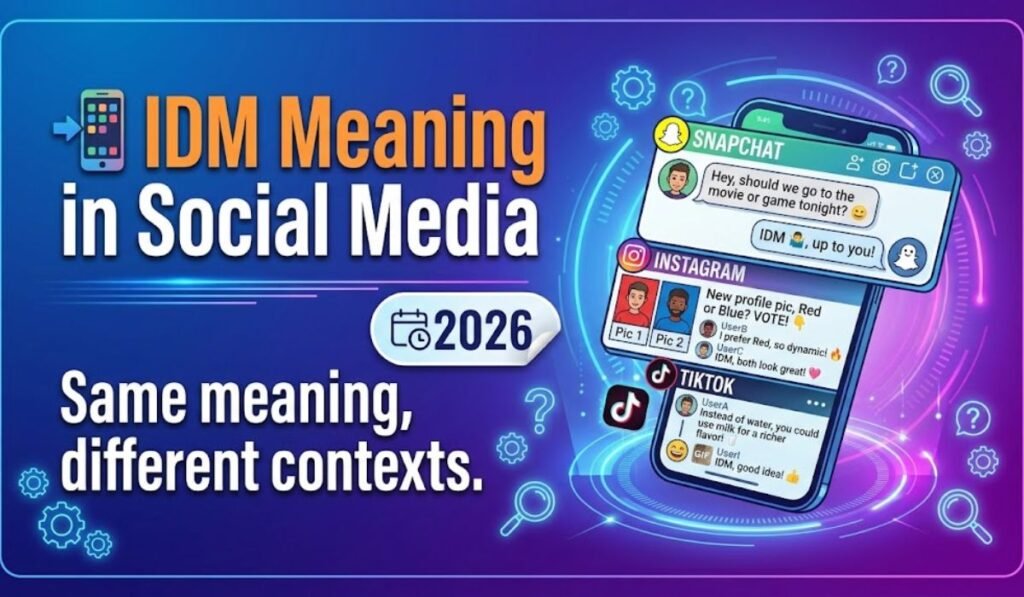
On platforms like Instagram, Snapchat, and TikTok, IDM keeps the same core meaning but shows up in slightly different formats. On Snapchat specifically, it’s commonly used the same way — signaling that someone has no strong preference when replying to a Snap or a chat question.
In Instagram comments, you might see it used more loosely — someone replying “idm” under a poll-style caption (“New profile pic, red or blue background?”) to say either option looks fine to them. In TikTok comment sections, it sometimes appears as a quick agreement to a suggestion made in the video or by another commenter.
The meaning doesn’t really shift across platforms. What changes is the formality — social media IDM tends to be even more casual and often paired with emojis or GIFs to soften the short reply.
👧 IDM Meaning Gen Z
For Gen Z texters, IDM fits into a broader habit of compressing feelings into minimal characters — similar to “idc,” “nvm,” or “lowkey.” It’s not usually meant to sound cold; it’s just the default shorthand for “either is fine” in fast-moving conversations.
Among younger users, IDM is also sometimes used with a hint of humor or sarcasm, especially when replying to an obviously one-sided question (“Should we get ice cream?” — “idm 😂” implying the answer is obviously yes, just phrased casually).
👩 IDM Meaning From a Girl
When a girl sends “idm,” the meaning doesn’t change based on gender — it still means she doesn’t have a strong preference and is comfortable with the decision. She’s simply open to whatever choice is made in the conversation.
Where confusion sometimes creeps in is when IDM is sent in a conversation with romantic undertones. A short “idm” in response to “Want to grab coffee sometime?” usually just means she’s open to it — not that she’s uninterested. If someone wants to read more into a short reply like this, the better move is to ask a clarifying follow-up rather than guess at hidden meaning.
🌐 Different Contexts Where IDM Appears
1. Text Messages and Chats
This is where IDM is most common — one-on-one texts where someone is asked to weigh in on a small decision, like timing, food, or plans.
2. Social Media Comments
Here IDM often responds to a poll-style question or a suggestion in someone’s post, usually paired with an emoji to keep the tone light.
3. Group Chats
In group settings, IDM is a quick way to avoid being the person who stalls a decision. When six people are debating where to eat, “idm” signals you’re fine going along with the majority.
💭 Examples of IDM in Conversation
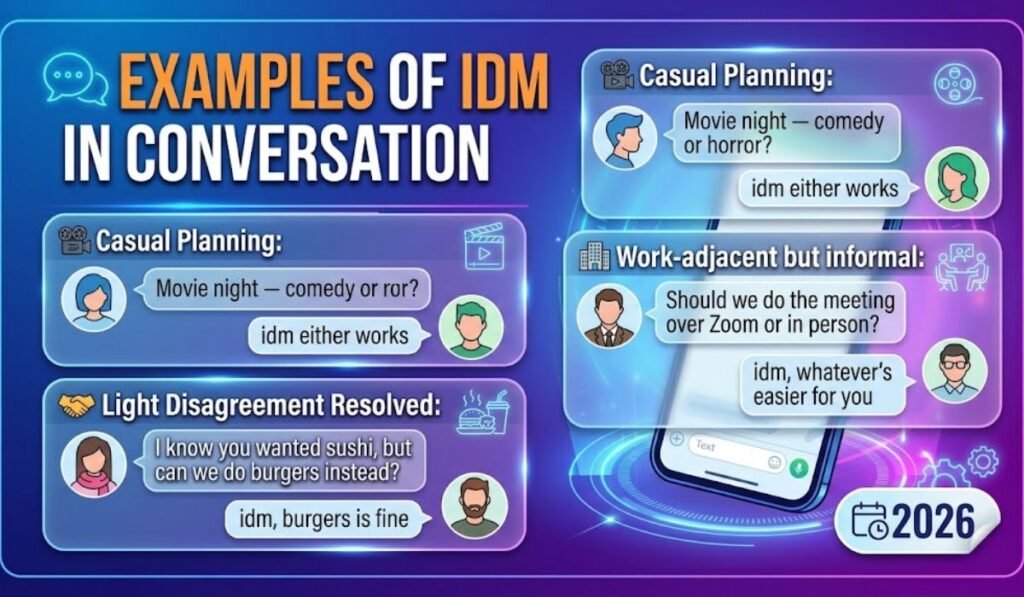
Casual planning:
A: “Movie night — comedy or horror?”
B: “idm either works”
Work-adjacent but informal:
A: “Should we do the meeting over Zoom or in person?”
B: “idm, whatever’s easier for you”
Light disagreement resolved:
A: “I know you wanted sushi, but can we do burgers instead?”
B: “idm, burgers is fine”
Notice that IDM rarely stands completely alone in natural conversation — people often add a few extra words (“you pick,” “either works,” “whatever’s easier”) to soften it and make the flexibility feel genuine rather than dismissive.
🔍 Less Common Meanings of IDM
Texting isn’t the only place IDM shows up, and it’s worth knowing the other definitions so you don’t mix them up in the wrong context.
IDM as “In Direct Message”
Occasionally, especially in business or customer-service style replies on social platforms, IDM gets used loosely to mean “in direct message” — as in, “I’ll send you the details IDM,” meaning through a private message rather than in the public comments. This usage is far less common than “I don’t mind” and usually only appears in specific customer-support or influencer contexts.
Professional or Technical Meanings
Outside of texting, IDM has several established meanings tied to specific industries. It can refer to Intelligent Dance Music, Identity Management, or Integrated Disease Management, depending on the field being discussed.
- Identity Management (IDM): used in IT and cybersecurity to describe systems that manage user identities and access permissions.
- Intelligent Dance Music (IDM): a genre of electronic music known for complex, experimental rhythms.
- Integrated Disease Management (IDM): a term used in healthcare and public health planning.
You’ll only encounter these meanings in specialized conversations — a tech forum, a music discussion, or a healthcare article. In a normal text thread, “I don’t mind” is essentially always the intended meaning.
🧩 How to Tell Which Meaning of IDM Is Intended
Context settles this almost instantly. A few quick checks:
- Who’s texting? If it’s a friend, partner, or group chat, it’s “I don’t mind.”
- What’s the topic? If the conversation is about music production, software, or healthcare systems, it’s likely one of the technical meanings.
- What came before it? IDM as a reply to a question or suggestion is “I don’t mind.” IDM introducing new information is unusual and worth a second look.
In practice, you’ll almost never need to guess — the surrounding message makes the intended meaning obvious within a sentence or two.
❌ Common Misunderstandings About IDM
Misconception 1: IDM Means Disinterest
Because it’s short, IDM sometimes gets misread as dismissive. In reality, it usually reflects genuine flexibility — the person just doesn’t have a preference. If tone is genuinely a concern, that’s usually about the overall conversation, not the abbreviation itself.
Misconception 2: IDM Is Rude
IDM isn’t inherently rude. It’s neutral and polite in most everyday situations, and only risks feeling curt if it’s sent as a one-word reply in a moment that called for more warmth or detail.
Misconception 3: IDM Is Only for Teenagers
While it’s common among younger texters, IDM is used across age groups in casual digital communication — coworkers use it in informal Slack messages, adults use it in family group chats, and it appears in plenty of non-teen contexts.
🎯 Is IDM Formal or Informal?
IDM is informal. It belongs in texts, DMs, and casual chats — not in emails, cover letters, or professional documents. Using it in a formal setting, even a semi-casual work chat with someone you don’t know well, can come across as too relaxed for the context. When formality matters, spelling out “I don’t mind either way” reads as more thoughtful and complete.
🔄 Alternatives to IDM in Texting
Common Alternatives
- “idc” — I don’t care (can feel more indifferent than IDM)
- “up to you”
- “either works”
- “whatever you prefer”
Slightly More Polite Versions
- “I’m happy either way”
- “no preference, you choose”
- “totally fine with whatever works for you”
These alternatives carry the same core meaning as IDM but add a bit more warmth, which matters in conversations where tone needs to come through clearly — like with someone you don’t know well, or in a slightly more serious discussion.
⚖️ IDM vs Similar Text Acronyms
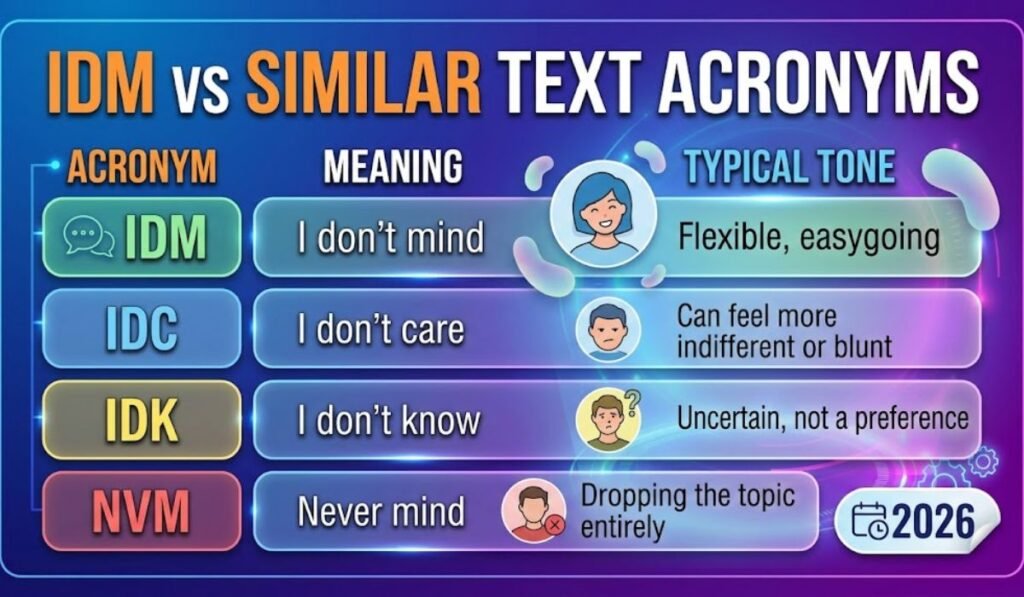
| Acronym | Meaning | Typical Tone |
| IDM | I don’t mind | Flexible, easygoing |
| IDC | I don’t care | Can feel more indifferent or blunt |
| IDK | I don’t know | Uncertain, not a preference |
| NVM | Never mind | Dropping the topic entirely |
IDM signals that a person is okay with a choice, while IDK reflects not having an answer, and IDC can come across as more direct or less concerned about the outcome. Mixing these up changes the message significantly — “idm where we eat” and “idc where we eat” sound similar but land differently, with the second often feeling more detached.
🚫 When You Should Avoid Using IDM
- In formal or professional messages — emails, job applications, or first messages to someone you don’t know well.
- When someone needs a real opinion — if a friend is stressed about a decision and genuinely wants your input, “idm” can feel like you’re avoiding the question.
- In emotionally important conversations — replying “idm” to something like “should we talk about us?” can come across as avoidant rather than flexible.
- With people who don’t use texting slang — older relatives, new coworkers, or anyone who might not immediately recognize the abbreviation.
🧠 Why Understanding IDM Matters
Small abbreviations like IDM carry more weight than their length suggests. Misreading one — assuming disinterest when someone meant flexibility, or vice versa — can create unnecessary tension in an otherwise simple exchange. Knowing what IDM actually means, and reading it in context rather than in isolation, keeps everyday texting smoother and prevents awkward follow-up questions like “wait, are you mad?”
✅ Examples of Correct and Incorrect Usage
Correct Usage
- “idm what we watch, you choose” — casual, low-stakes decision.
- “Coffee or tea?” / “idm, either’s good” — clear, appropriate context.
- In a group chat deciding on a meeting time: “idm, any slot works for me.”
Incorrect Usage
- Using it in a formal email: “Regarding the proposal, idm.” (Too casual for the setting.)
- Replying “idm” to “Are you upset with me?” (Comes across as avoidant rather than reassuring.)
- Sending “idm” as your only response to a first message from a new contact who may not know the abbreviation.
📈 How IDM Reflects Modern Communication Trends
IDM is part of a much bigger shift toward efficient, low-friction digital conversation. As messaging has moved from formal letters to instant texts, language has compressed to match the pace — full sentences turned into abbreviations, and abbreviations turned into emojis layered on top of abbreviations. IDM sits comfortably in that evolution: short enough to be fast, but still recognizable enough that it hasn’t needed to change meaning over time.
😊 Is IDM Rude or Friendly?
In the vast majority of everyday texting situations, IDM is friendly — or at worst, neutral. It signals ease and flexibility rather than rudeness. The exceptions are situational rather than inherent to the term itself: sent without warmth in a serious moment, it can read as flat, but that’s about timing and context, not the abbreviation being impolite by nature.
Frequently Asked Questions About IDM Meaning in Text
What does IDM mean in a text message?
IDM stands for “I don’t mind.” It’s used to show you’re okay with a decision, choice, or suggestion without a strong preference either way.
Is IDM the same as IDC?
Not exactly. IDM shows flexibility and openness, while IDC (“I don’t care”) can sound more indifferent or blunt, depending on tone and context.
Does IDM mean someone is not interested?
Not usually. It typically means the opposite — the person is comfortable with any option. Tone and context, not the abbreviation itself, usually create that impression.
What does IDM mean on Snapchat or Instagram?
The meaning stays the same across platforms — “I don’t mind.” It’s commonly used in casual replies, comments, and DMs when someone has no strong preference.
Is it okay to use IDM in a professional message?
Generally, no. IDM is informal and works best in casual texts or chats. For work emails or formal messages, spell out “I don’t have a preference” instead.
What does IDM mean from a girl or a guy?
The meaning doesn’t change by gender — it means the person doesn’t have a strong preference and is comfortable with the outcome either way.
Can IDM mean something other than “I don’t mind”?
Yes. Outside texting, IDM can also stand for Identity Management, Intelligent Dance Music, or Integrated Disease Management, depending on the topic being discussed.
How should I reply to “idm”?
You can simply proceed with a decision, since “idm” hands the choice to you. A short “cool, let’s do that then” keeps the conversation moving naturally.
Is IDM still used in 2026?
Yes. It remains a common, widely understood texting abbreviation, especially in casual chats and group messages among younger users.
Conclusion
IDM is a small piece of texting shorthand with one main job: signaling that you’re flexible and easy to please. Read on its own, it can occasionally feel ambiguous, but paired with the conversation around it, the meaning is almost always clear — someone is simply saying “either option works for me.” Knowing when it fits, and when a fuller sentence serves the moment better, is really all it takes to use it well.
