
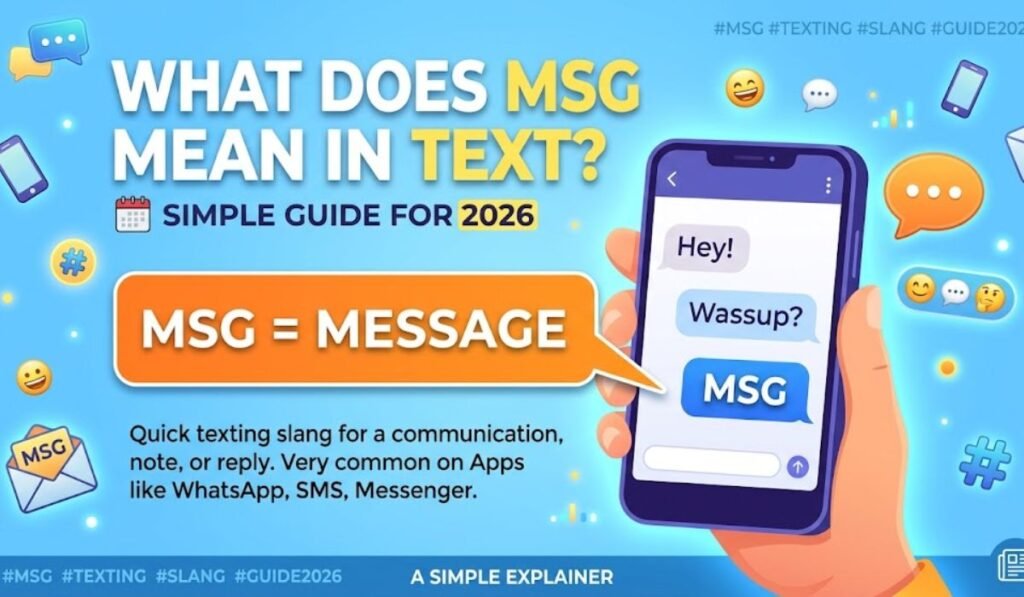
You’re texting a friend and they type, “just send me a msg when you land.” You know roughly what they mean, but you pause anyway — what does MSG actually stand for? If you’ve spotted it on WhatsApp, Snapchat, gaming chats, or Instagram comments, you’re definitely not the only one who’s wondered. This guide breaks down exactly what MSG means, where it comes from, and how to use it naturally without sounding out of place.
⚡ Quick Answer
MSG is a texting abbreviation for “message.” People use it to save time and keystrokes when chatting online — as a noun (“send me a msg”) or a verb (“msg me later”). It’s casual, widely understood, and works across nearly every messaging app and social platform.
What Does MSG Mean in Text?
In almost every texting context, MSG simply means message. It’s one of the oldest and most recognizable texting shortcuts, used long before smartphones existed, back when SMS messages were limited to 160 characters and every letter counted.
People use MSG in two main ways:
- As a noun: “Did you get my msg?”
- As a verb: “I’ll msg you tonight.”
Because it’s short — just three letters instead of seven — it fits naturally into fast, informal conversations where full sentences feel unnecessary.
MSG Meaning: Urban Dictionary
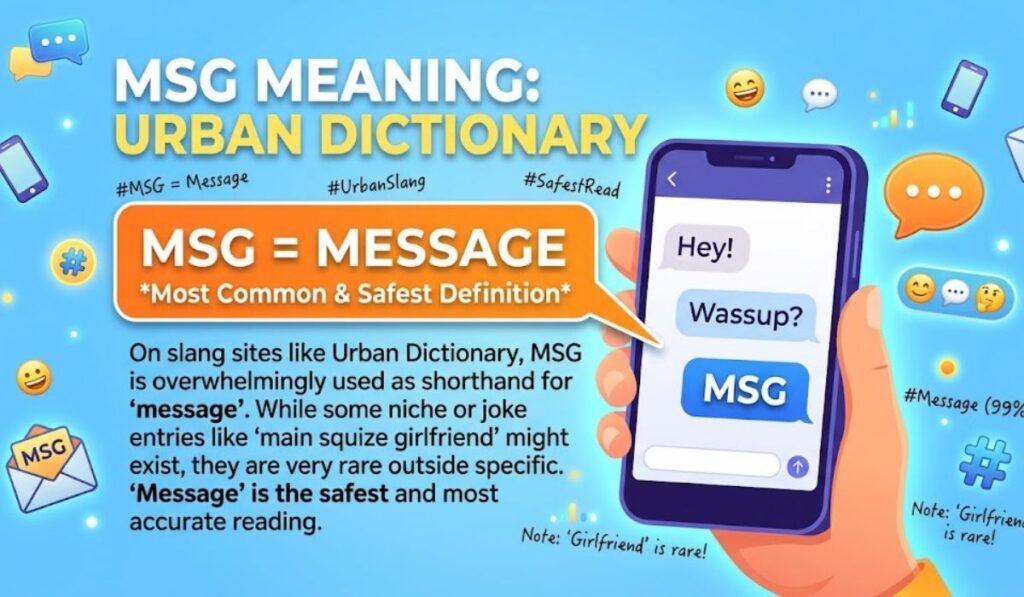
On slang reference sites and crowd-sourced dictionaries, MSG is overwhelmingly defined as shorthand for “message,” though a handful of niche or joke entries occasionally pop up (some users have used it playfully to mean “main squeeze girlfriend” or similar inside jokes). These alternate definitions are rare and almost never show up outside of very specific friend groups, so if you see MSG in a normal conversation, “message” is by far the safest and most accurate reading.
MSG Meaning in Food
Outside of texting, MSG has a completely different and much older meaning: monosodium glutamate, a flavor-enhancing seasoning commonly used in Asian cuisine, packaged snacks, and processed foods. It’s the compound responsible for the savory “umami” taste in many dishes.
For decades, MSG in food carried an unfair reputation tied to so-called “Chinese Restaurant Syndrome,” a term now widely considered outdated and rooted in bias rather than solid evidence. Regulatory bodies generally recognize MSG as safe for consumption in normal amounts, though people with specific sensitivities should still consult a doctor or dietitian if they experience symptoms after eating foods that contain it.
The key takeaway: context tells you which MSG you’re dealing with. In a text conversation, it’s almost always “message.” In a recipe or nutrition label, it’s the seasoning.
Where Is MSG Commonly Used? 📍
MSG shows up anywhere people communicate quickly and casually online.
Popular Platforms:
- Texting / iMessage / SMS — the original home of MSG
- WhatsApp — common in both one-on-one chats and group threads
- Instagram & Snapchat — used in DMs and story replies
- Discord & gaming chats — quick callouts during matches
- TikTok comments — asking someone to reply or reach out
- Email (informal only) — occasionally used between coworkers who know each other well
Tone & Style:
MSG carries a relaxed, low-effort tone. It’s not rude or dismissive by default — it simply signals that the conversation is casual rather than formal. You wouldn’t typically use it in a job application or a message to your boss, but it fits comfortably almost everywhere else.
Examples of MSG in Conversation 💬
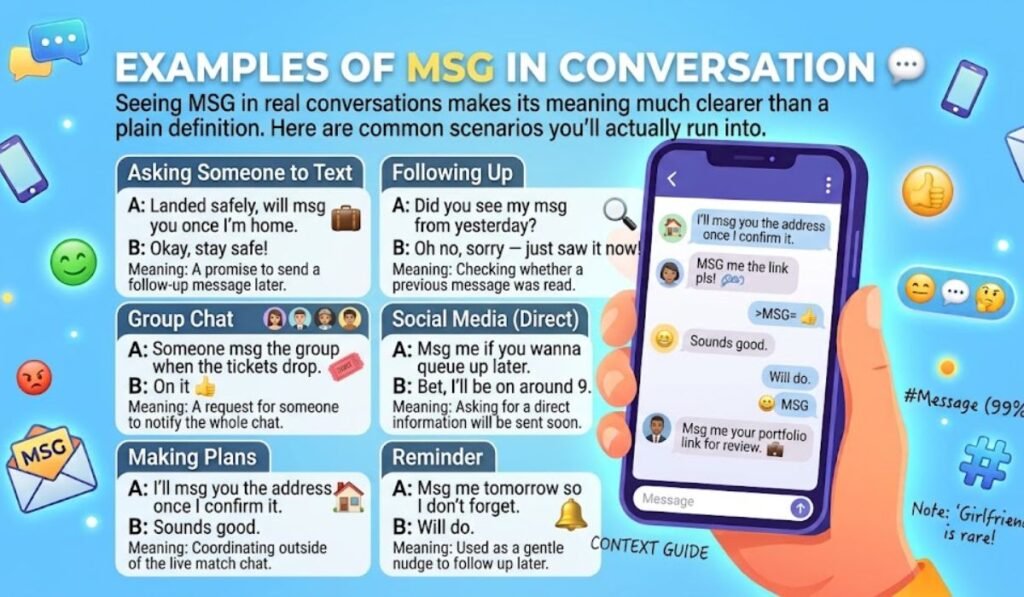
Seeing MSG in real conversations makes its meaning much clearer than a plain definition. Here are common scenarios you’ll actually run into.
1. Asking Someone to Text
Person A: “Landed safely, will msg you once I’m home.”
Person B: “Okay, stay safe!”
Meaning: A promise to send a follow-up message later.
2. Following Up
Person A: “Did you see my msg from yesterday?”
Person B: “Oh no, sorry — just saw it now!”
Meaning: Checking whether a previous message was read.
3. Group Chat
Person A: “Someone msg the group when the tickets drop.”
Person B: “On it 👍”
Meaning: A request for someone to notify the whole chat.
4. Social Media
Person A (comment): “Msg me the link pls!”
Meaning: Asking for a direct message rather than a public reply.
5. Gaming Chat
Person A: “Msg me if you wanna queue up later.”
Person B: “Bet, I’ll be on around 9.”
Meaning: Coordinating outside of the live match chat.
6. Making Plans
Person A: “I’ll msg you the address once I confirm it.”
Person B: “Sounds good.”
Meaning: A pending piece of information will be sent soon.
7. Reminder
Person A: “Msg me tomorrow so I don’t forget.”
Person B: “Will do.”
Meaning: Used as a gentle nudge to follow up later.
When to Use and When Not to Use MSG
When to Use MSG
- Texting friends, family, or close coworkers
- Casual group chats
- Gaming or Discord servers
- Social media DMs and comments
- Any low-stakes, informal exchange
When Not to Use MSG
- Job applications or resumes
- First messages to new professional contacts
- Formal emails or business proposals
- Customer service or legal correspondence
- Any situation where clarity and professionalism matter more than speed
A simple rule: if you’d type out “please” and “thank you” in full, you probably shouldn’t shorten “message” to MSG either.
Other Meanings of MSG in Text
While “message” is the dominant meaning, MSG can occasionally stand for other things depending on the group or platform:
- Monosodium glutamate — the food additive, unrelated to texting
- Madison Square Garden — the New York arena, often abbreviated this way in sports and event chats
- Military/Government terms — such as “Master Sergeant,” used mostly in formal or military contexts, not casual texting
- Inside jokes or niche slang — occasionally created within specific friend groups, though these aren’t widely recognized
If MSG doesn’t make sense as “message” in a sentence, check the surrounding context — sports talk, food discussions, or military references usually make the alternate meaning obvious.
Similar Slang Words or Alternatives
Several other abbreviations overlap with or relate to MSG in casual texting:
| Abbreviation | Meaning |
| DM | Direct Message |
| TXT | Text |
| PM | Private Message |
| RN | Right Now |
| WYD | What You Doing |
| WSG | What’s Good (a greeting, easily confused with MSG) |
Of these, WSG is the one most often mixed up with MSG because the letters look similar at a glance. WSG is a greeting (“what’s good”), while MSG refers to a message itself — two completely different meanings that just happen to share a letter pattern.
Why Do People Use MSG Instead of “Message”?
1. Saves Time
Typing three letters instead of seven adds up across dozens of daily texts, especially on a phone keyboard.
2. Makes Texting Faster
Fast-paced conversations, especially in group chats or gaming lobbies, benefit from shorter words that don’t slow down the back-and-forth.
3. Feels More Casual
Using MSG signals a relaxed, informal tone — it reads as friendly shorthand rather than a stiff, complete sentence.
4. Common Across Many Apps
Because MSG has been used since early SMS days, it’s understood almost universally, unlike newer slang that might only make sense to a specific age group or platform.
Is MSG Friendly or Rude? 🙂
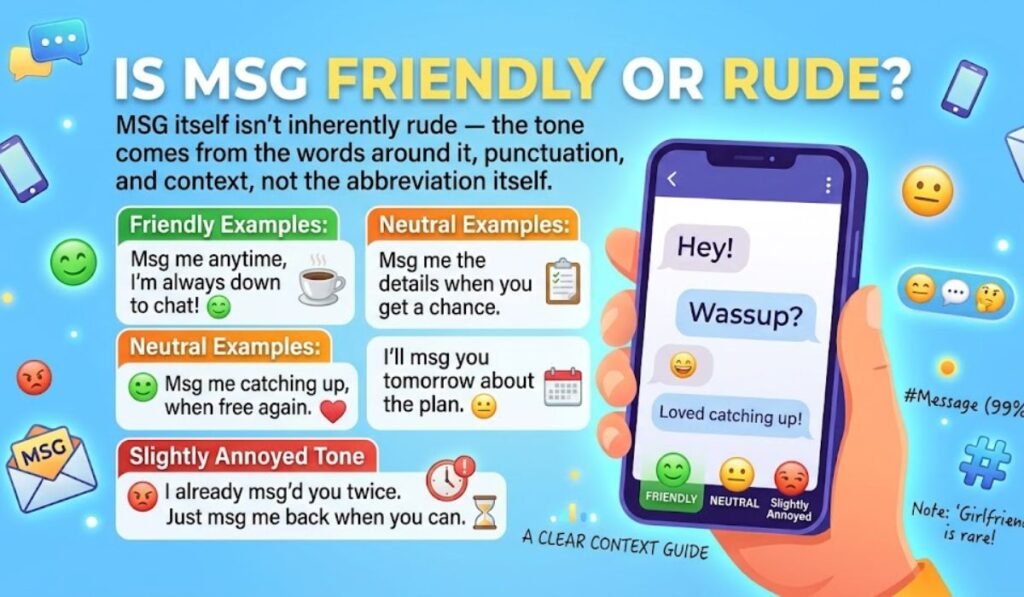
MSG itself isn’t inherently rude — the tone comes from the words around it, punctuation, and context, not the abbreviation itself.
Friendly Examples
- “Msg me anytime, I’m always down to chat! 😊”
- “Loved catching up, msg me when you’re free again.”
Neutral Examples
- “Msg me the details when you get a chance.”
- “I’ll msg you tomorrow about the plan.”
Slightly Annoyed Tone
- “I already msg’d you twice.”
- “Just msg me back when you can.”
Notice that the abbreviation stays the same in every example — what changes is punctuation, added emojis, and word choice around it.
How MSG Is Used on Social Media
Snapchat
Used in chat and story replies, often paired with quick, low-effort responses like “msg me back” after someone views a snap.
TikTok
Common in comment sections when someone wants a private conversation instead of a public reply, such as “msg me for details.”
Frequently seen in DMs and comments, especially for coordinating plans, sharing links, or following up on a story reply.
Gaming Chats
Used to move conversations out of a live match into direct messages, like coordinating a squad for later.
One of the most common places to see MSG, since WhatsApp itself is built entirely around messaging, making the abbreviation feel almost redundant but still widely used out of habit.
Frequently Asked Questions About MSG Mean in Text
What does MSG mean in a text message?
MSG is short for “message.” People use it to refer to a text, DM, or any written communication sent through a messaging app, usually to save time while typing.
Is MSG the same as DM?
Not exactly. MSG is a general word for any message, while DM specifically refers to a direct/private message on social media platforms like Instagram or Twitter/X.
Can MSG mean something other than message?
Yes. Outside of texting, MSG can refer to monosodium glutamate (a food seasoning), Madison Square Garden, or military ranks like Master Sergeant, depending on the context.
Is it rude to say “msg me”?
No, it’s not rude by itself. It’s a casual, neutral phrase. Tone depends on punctuation, emojis, and the words surrounding it, not the abbreviation itself.
Do older generations understand MSG?
Yes. MSG has been used since early SMS texting, so it’s recognized across age groups, unlike some newer Gen Z-specific slang terms.
What’s the difference between MSG and WSG?
MSG means “message,” while WSG means “what’s good,” a casual greeting. They’re easy to confuse visually but mean completely different things.
Is MSG appropriate for professional messages?
Generally, no. It’s best kept for casual texting, group chats, and social media. Formal emails or professional messages should use the full word “message.”
Why do people abbreviate “message” to MSG?
Mainly for speed and casual tone. Shortening common words is a habit built into texting culture, especially in fast-moving conversations like group chats or gaming.
Final Thoughts
MSG is one of the simplest, most widely recognized texting abbreviations out there, standing for “message” in the vast majority of conversations you’ll come across. Its meaning barely shifts across platforms — whether you’re on WhatsApp, Snapchat, or a gaming chat, “msg” almost always points back to the same idea: a message someone sent or wants to send. Keep the food and sports meanings in mind for the rare moments context calls for them, but in everyday texting, you can trust MSG to mean exactly what it looks like.
