

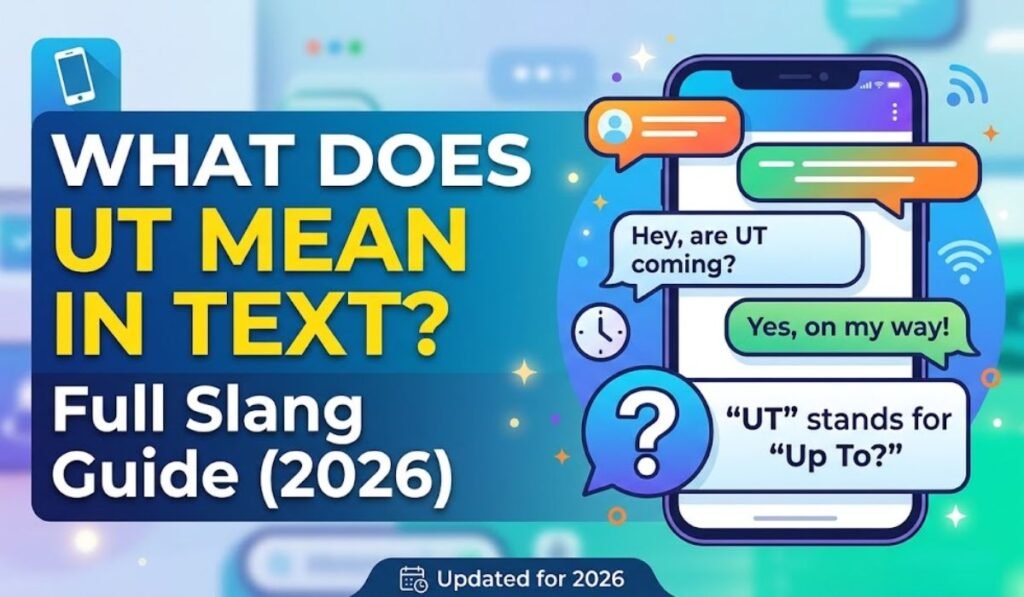
You’re mid-conversation, you send a message, and thirty minutes later you get back a single “ut?” No punctuation, no context — just two letters. If you’ve been left staring at your screen trying to decode it, you’re not alone. This guide breaks down exactly what UT means in text, where it shows up, and how to reply so you’re never caught off guard again.
⚡ Quick Answer: What Does UT Mean?
In most texting and chat conversations, UT means “You There?” — a short way of asking if someone is still active in the conversation. It’s most common on messaging apps and social platforms. Less often, UT can also mean “you too” or refer to Universal Time in technical writing.
What Does UT Mean in Text? 📱
At its core, UT is a shorthand check-in. Instead of typing out “are you there?” or “are you still with me?”, people compress it down to two letters. It usually shows up when someone has sent a message and hasn’t gotten a reply in a while, or when they’re about to share something and want to confirm you’re paying attention first.
The tone behind UT is almost always casual. It’s not a formal abbreviation you’d see in a business email — it belongs firmly in the world of texting, DMs, and group chats.
Simple Meaning Breakdown 🧩
Here’s the quickest way to think about it:
- U = You
- T = There
- Full phrase = “Are you there?”
It functions less like a question and more like a nudge. Someone sends “ut” the same way they might send a single wave emoji — a low-effort way of saying “hey, checking in.”
UT Meaning Urban Dictionary 📖
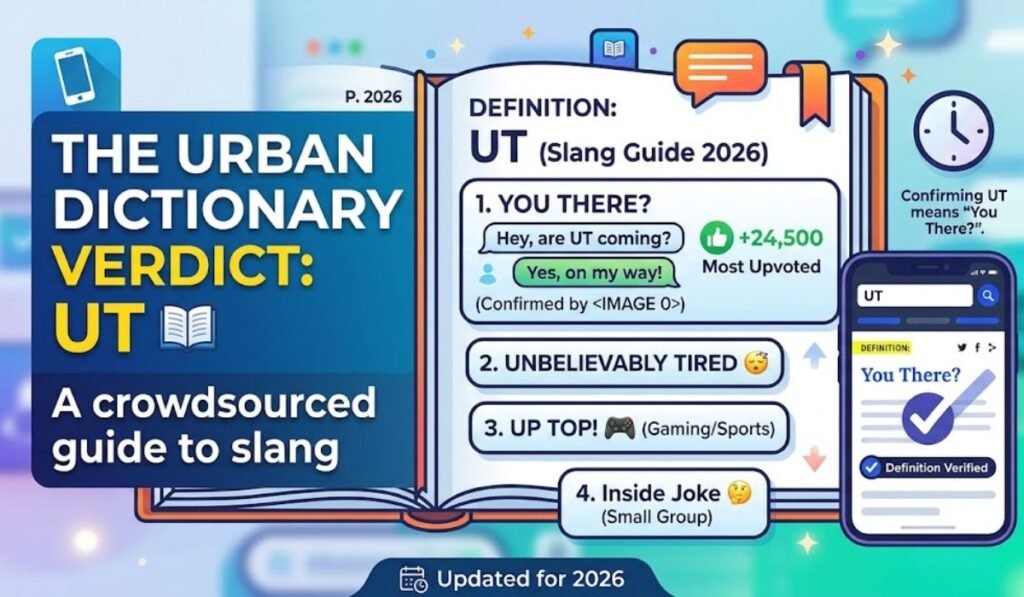
Crowdsourced slang dictionaries like Urban Dictionary generally back up the “you there?” interpretation as the dominant meaning, since that’s the definition most upvoted and referenced by everyday users. That said, slang dictionaries are user-submitted, so you’ll also find entries listing UT as shorthand for “unbelievably tired,” “up top” (in gaming or sports contexts), or even inside jokes specific to a small friend group.
The takeaway: crowdsourced definitions confirm “you there?” as the most widely recognized meaning, but they also show how flexible internet slang can be. If a definition feels off for your conversation, context always wins over the dictionary entry.
UT Meaning in Chat From a Girl 👩💻
People sometimes search this specific phrase because they’ve received “ut” from someone they’re texting romantically or getting to know, and they’re trying to figure out if it means something more. In almost every case, the meaning doesn’t change based on who sends it — UT still means “you there?”
What does change is the emotional context around it:
- If she’s been texting you actively and sends “ut 👀” after a pause, she’s probably just curious why you went quiet.
- If it comes after a long gap with no punctuation or emoji, it may simply be a casual check-in with no deeper meaning attached.
- If it’s paired with something like “ut? miss talking to u,” the surrounding words — not the abbreviation itself — are what signal interest.
Don’t overanalyze the two letters. Read the whole message, the emoji, and the conversation history for the real signal.
What Does UT Mean in Medical Terms? 🩺
Outside of texting, UT has a completely different, well-established meaning in healthcare: it commonly stands for urinary tract, as in a UTI (urinary tract infection). You might see “UT” used in clinical notes, lab results, or medical charts as shorthand for this anatomical system.
If you come across “UT” in a health-related document or message from a doctor’s office, it almost certainly refers to this medical meaning rather than the texting slang. This is a good reminder that abbreviations are entirely context-dependent — the same two letters can mean something casual in one setting and clinical in another. If you’re ever unsure what an abbreviation means in a medical document, ask your provider directly rather than guessing.
Where Is UT Commonly Used? 🌐
UT shows up most often in fast, informal digital spaces rather than formal writing.
Popular Platforms 📲
- Text messages (SMS/iMessage): The most traditional home for UT, especially in one-on-one conversations.
- Instagram and Snapchat DMs: Common when a conversation stalls and one person wants a quick response.
- Discord and gaming chats: Used to check if a teammate is still active mid-match.
- WhatsApp group chats: Sometimes used to ping someone who’s gone quiet in a group conversation.
Tone & Style 🎭
UT is almost always lowercase, often sent with minimal or no punctuation, and frequently followed or preceded by an emoji to soften it. A bare “UT.” in all caps with a period can come across as blunt or annoyed, while “ut? 👀” or “ut 😅” reads as playful and low-pressure.
Examples of UT in Conversation 💬
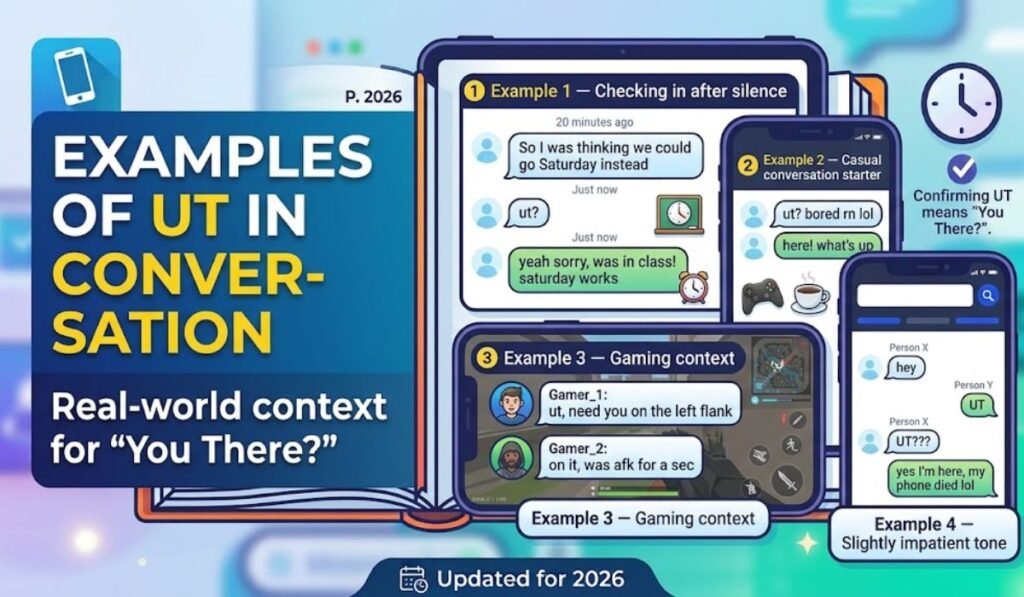
Seeing UT in context makes it much easier to understand than a dictionary definition alone.
Example 1 — Checking in after silence
Person A: “So I was thinking we could go Saturday instead” (20 minutes pass)
Person A: “ut?”
Person B: “yeah sorry, was in class! saturday works”
Example 2 — Casual conversation starter
Person A: “ut? bored rn lol”
Person B: “here! what’s up”
Example 3 — Gaming context
Person A: “ut, need you on the left flank”
Person B: “on it, was afk for a sec”
Example 4 — Slightly impatient tone
Person A: “hey”
Person B: “UT”
Person A: “UT???”
Person B: “yes I’m here, my phone died lol”
In each case, UT is doing the same job: confirming presence before continuing the conversation.
When to Use and When Not to Use UT ✅❌
When to Use UT
- With friends, siblings, or people you text casually
- In gaming or group chats where quick check-ins are normal
- When a conversation has gone quiet and you want a low-effort nudge
- Paired with an emoji to keep the tone light
When Not to Use UT
- In professional emails or work Slack messages
- With someone you don’t know well, where the abbreviation might confuse them
- In formal or academic writing
- Repeatedly in a row (sending “UT” three times in a minute can come across as pushy rather than curious)
Other Meanings of UT in Text 🔄
Because UT is only two letters, it overlaps with several other meanings depending on the situation:
| Meaning | Where You’ll See It |
| You There? | Texting, social media DMs |
| You Too | Casual replies to compliments or well-wishes |
| Universal Time | Science, astronomy, aviation, and tech contexts |
| Urinary Tract | Medical notes and healthcare conversations |
| University (e.g., University of Texas, University of Tennessee) | School and sports contexts |
If a friend texts “have a good day!” and you reply “ut 😊”, you’re using it as a quick version of “you too,” not “you there.” Context — not the letters themselves — tells you which meaning applies.
Similar Slang Words or Alternatives 🔤
Several other texting abbreviations serve a similar “checking in” purpose, and knowing the differences helps you pick the right one:
- WYA (“where you at”) — asks about location or availability, slightly more direct than UT
- WYD (“what you doing”) — opens a conversation rather than just checking presence
- HRU (“how are you”) — a warmer check-in focused on the person’s wellbeing
- YT (“you there”) — functions almost identically to UT, just with different letters
- BRB (“be right back”) — the opposite move: telling someone you’re stepping away
Among these, WYA and YT are closest in function to UT, while WYD and HRU carry a bit more conversational warmth.
Is UT Friendly or Rude? 😊😐😤
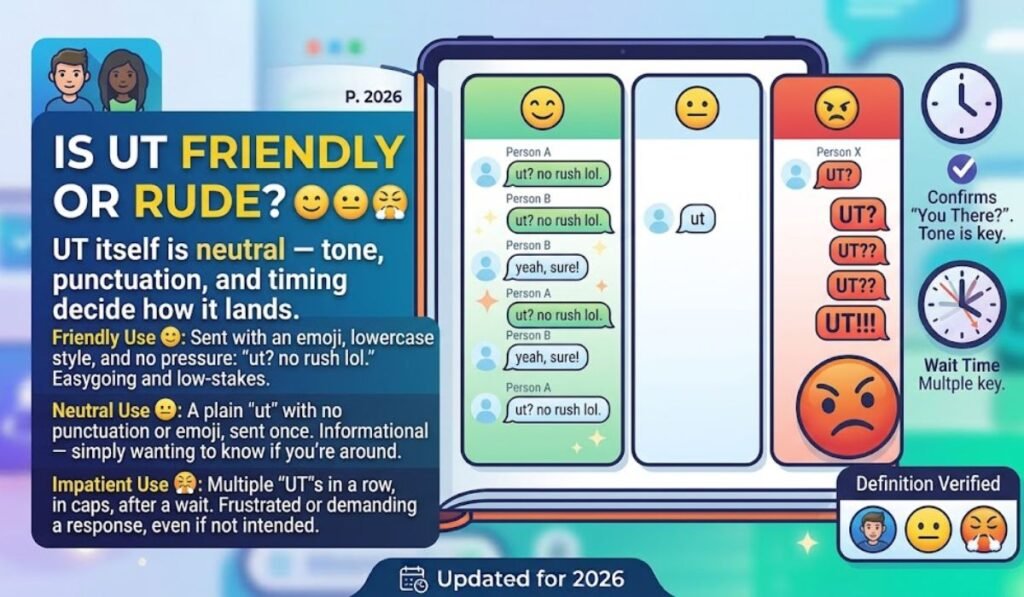
UT itself is neutral — the surrounding tone, punctuation, and timing decide how it lands.
Friendly Use 😊
Sent with an emoji, a lowercase style, and no pressure: “ut? no rush lol.” This reads as easygoing and low-stakes.
Neutral Use 😐
A plain “ut” with no punctuation or emoji, sent once. This is simply informational — the sender wants to know if you’re around, nothing more.
Impatient Use 😤
Multiple “UT”s in a row, in caps, especially after a long wait. This can come across as frustrated or demanding a response, even if that’s not the sender’s intent.
If you’re not sure how your own “UT” will be read, adding a soft emoji or a short follow-up (“ut? no worries if not”) removes the ambiguity.
Why Do People Use UT in Texting? 🤔
1. Faster Communication ⚡
Typing “ut” takes a fraction of the time of typing “are you there,” which matters in fast-moving conversations where speed is part of the appeal.
2. Casual Chat Style 💬
Shortened language signals a relaxed, informal tone. Using full sentences in a group chat can sometimes feel overly formal compared to peers who default to abbreviations.
3. Gaming Culture 🎮
In multiplayer games, players often can’t type long messages mid-match. Quick check-ins like “ut” let teammates confirm someone is still active without breaking focus.
4. Social Media Trends 📈
Platforms like TikTok and Instagram have normalized abbreviated, meme-influenced language across comments and DMs, and UT fits naturally into that shorthand culture alongside terms like WYD and NGL.
Frequently Asked Questions About UT Mean in Text
What does UT mean in texting?
UT most commonly means “You There?” — a quick way to check if the person you’re messaging is still active in the conversation.
Is UT rude to send?
No, UT is not inherently rude. It’s generally seen as a casual, low-effort check-in. Tone depends on punctuation, repetition, and emoji use rather than the abbreviation itself.
Does UT mean the same thing on every platform?
Mostly, yes. Across texting, Instagram, Snapchat, and Discord, UT typically means “you there?” The main exceptions are technical or medical contexts, where it can mean Universal Time or urinary tract.
How should I reply to UT?
A simple, direct reply works best: “yeah, here!” or “sorry, was busy — what’s up?” You don’t need to explain your absence in detail unless you want to.
Can UT mean “you too”?
Yes. If someone says something like “good luck!” and you reply “ut,” it’s shorthand for “you too” rather than “you there.” Context makes the difference clear.
Is UT still commonly used in 2026?
UT is still recognized and used, though newer abbreviations like WYA have become more popular in some Gen Z circles. It hasn’t disappeared, but it’s no longer the default check-in phrase for everyone.
What does UT mean in a school or university context?
UT is often shorthand for university names, most notably the University of Texas or University of Tennessee, especially in sports, admissions, or campus-related conversations.
Is UT used more by a specific age group?
It’s used across age groups, but it’s especially common among teens and young adults who grew up texting and gaming, where short check-in phrases are second nature.
Final Thoughts
UT is a small abbreviation that carries a lot of context depending on where you see it. In the vast majority of texts and DMs, it simply means “you there?” — a quick nudge to see if a conversation is still active. Outside of texting, the same two letters can point to something completely different, from Universal Time to a university name to a medical term. The safest approach is always the same: look at the conversation around it, and the real meaning becomes obvious fast.
