
Scrolling through a group chat and someone just replied “frl?” to your story. You know it’s not a typo, but you’re not totally sure what they’re asking. You’re in good company — this is one of the most-searched texting acronyms among teens and young adults right now, and it shows up everywhere from DMs to classroom reports.
Here’s the short version: FRL almost always means “For Real.” Below, you’ll get the full breakdown of what it means depending on where you see it, how to use it naturally, and when to leave it out of your texts entirely.
⚡ Quick Answer: What Does FRL Mean?
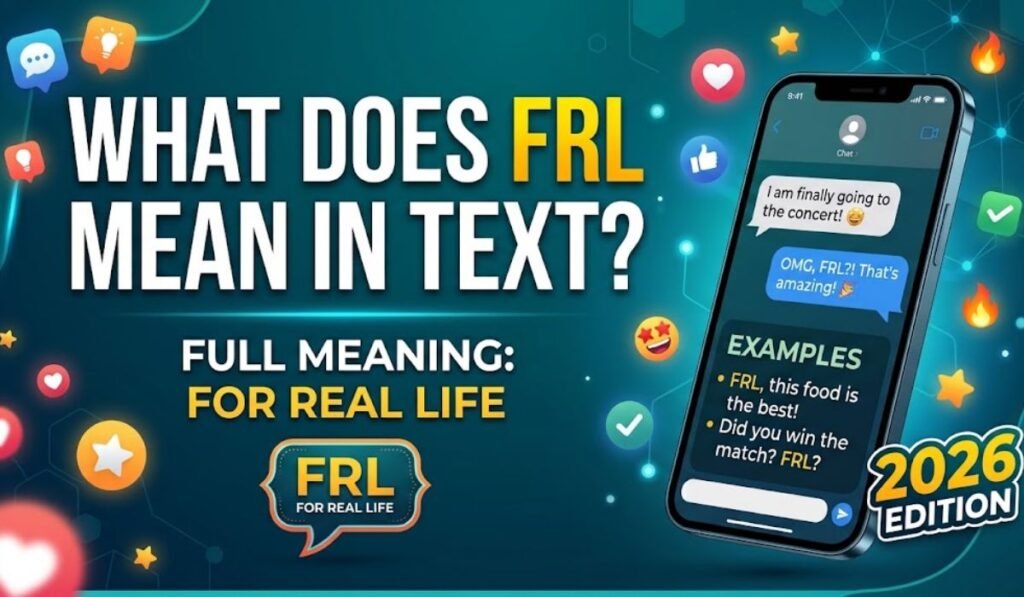
FRL mean in text is “For Real.” People use it to show they’re being honest, to agree with someone, or to react with disbelief — similar to saying “seriously” or “no cap.” A less common variation, “For Real, Laughing,” appears occasionally but isn’t the standard meaning.
What Does FRL Mean in Text? 💬
In everyday texting, FRL is shorthand for “For Real.” It works almost like a stamp of authenticity at the end of a sentence, or as a standalone question when someone can’t quite believe what they just heard.
The phrase carries three main uses:
- Confirming something is true — “I got the job, frl.”
- Reacting with surprise or disbelief — “frl?? that’s insane.”
- Agreeing with someone else’s point — “frl, that show got so much better this season.”
This term is a shortened version of the phrase “for real,” which itself has roots in African American Vernacular English (AAVE), where it’s long been used to affirm sincerity or push back on doubtbefore spreading into wider digital slang as a marker of authenticity and earnestness. As texting culture pushed people toward shorter, faster messages, “for real” naturally compressed into FRL, joining a wave of similar clipped phrases from the same era.
You’ll usually see it written in lowercase (“frl”) since most casual slang skips capitalization, though it works fine capitalized too, especially for emphasis.
FRL Meaning From a Guy 👨
FRL doesn’t have a separate definition depending on gender — a guy texting “frl” means exactly the same thing as anyone else: “for real.” That said, context can shift the emotional weight behind it.
If a guy sends “frl” after a compliment or an emotional text (“I really like talking to you, frl”), it’s usually adding sincerity, not sarcasm. He’s underlining that he means it. On the flip side, “frl?” as a solo reply to something you said is usually just genuine curiosity or mild disbelief, not flirtation.
The safest way to read it: look at what came before it. FRL amplifies whatever tone the message already has — it rarely creates a new one on its own.
What Does FRL Mean on Instagram? 📸
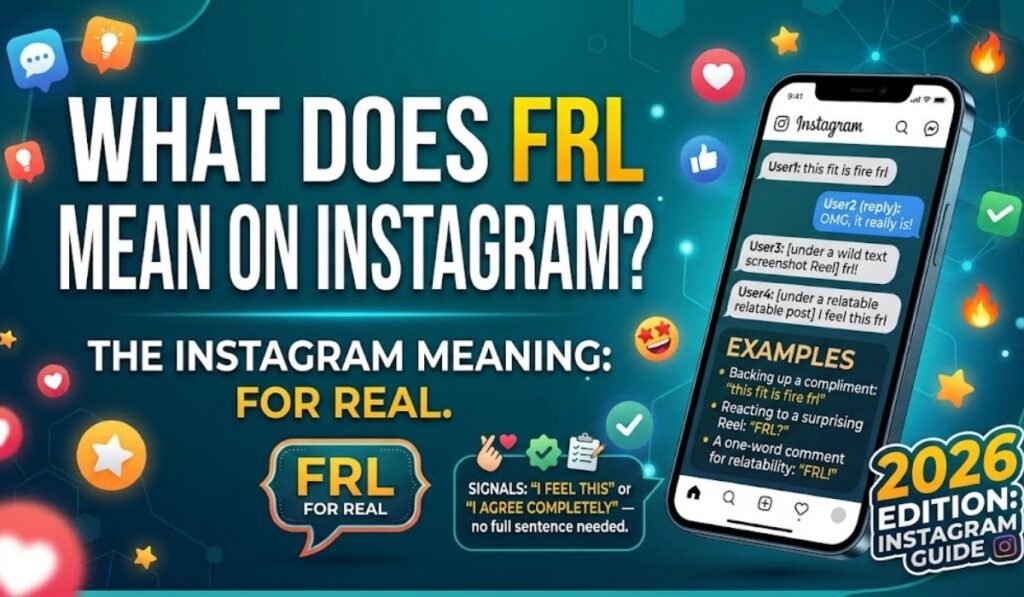
On Instagram, FRL shows up most often in comments, captions, and Story replies, and it means the same “for real.” People drop it under a friend’s post to back up a compliment (“this fit is fire frl”) or to react to something surprising in a Reel.
It’s especially common as a one-word comment on posts that feel relatable or dramatic — think a screenshot of a wild text exchange or a caption about a rough day. Commenting “frl” signals “I feel this” or “I agree completely,” without needing a full sentence.
What Does FRL Mean in Education? 🏫
Outside of texting, FRL has a completely different meaning in schools and education policy: Free and Reduced-Price Lunch. This is a federal program under the National School Lunch Program that provides meals at no cost, or at a reduced price, to students from lower-income households covering families that qualify based on income eligibility guidelines.
In this context, FRL status is often used as a rough indicator of a school’s economic makeup. School districts and researchers have long tracked the share of students receiving free or reduced-price lunch as a stand-in measure for poverty levels, since it’s collected consistently across schools. Eligibility is generally tied to a household’s income relative to the federal poverty line, with different thresholds for free versus reduced-price meals.
If you’re a parent, teacher, or student reading a school report and see “FRL rate” or “FRL eligibility,” it has nothing to do with texting slang — it’s referring to this meal assistance program and how many students in a school qualify for it.
Where Is FRL Commonly Used? 🌍
FRL shows up across nearly every messaging and social platform, though the tone shifts slightly depending on where you see it:
- Text messages and iMessage — used casually between friends to confirm or react
- TikTok — common in comments and captions to back up a claim or reactionemphasizing authenticity or showing that someone is being serious
- Instagram — used in comments and Story replies
- Twitter/X — used to agree with or amplify a post, often replacing a longer reply
- Snapchat — used in captions or chat to react quickly to something shared
It’s rare to see FRL in professional emails, LinkedIn messages, or formal writing. It lives almost entirely in casual, peer-to-peer communication.
Examples of FRL in Conversation 💭
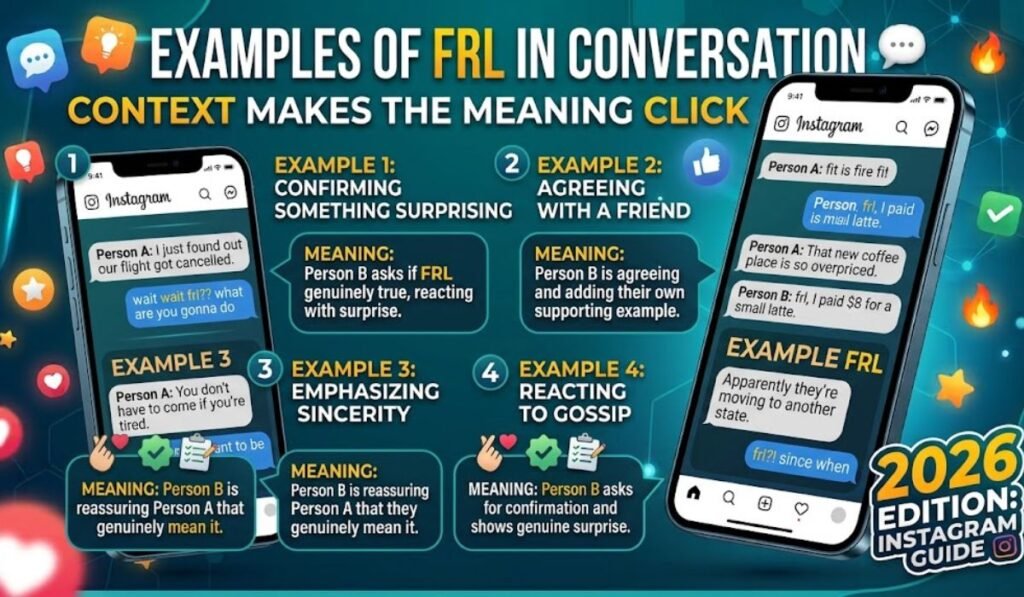
Seeing FRL in context makes the meaning click faster than any definition. Here are a few realistic exchanges:
Example 1 — Confirming something surprising
Person A: “I just found out our flight got cancelled.”
Person B: “wait frl?? what are you gonna do”
Meaning: Person B is asking if this is genuinely true, reacting with surprise.
Example 2 — Agreeing with a friend
Person A: “That new coffee place is so overpriced.”
Person B: “frl, I paid $8 for a small latte.”
Meaning: Person B is agreeing and adding their own supporting example.
Example 3 — Emphasizing sincerity
Person A: “You don’t have to come if you’re tired.”
Person B: “no I want to be there, frl.”
Meaning: Person B is reassuring Person A that they genuinely mean it.
Example 4 — Reacting to gossip
Person A: “Apparently they’re moving to another state.”
Person B: “frl?! since when”
Meaning: Person B is asking for confirmation and showing genuine surprise.
How to Reply to FRL 💡
If someone sends you a standalone “frl?” they’re usually asking you to confirm something. The easiest replies are:
- “Yeah frl” — confirms it’s true
- “Nah I’m exaggerating lol” — walks it back if it wasn’t fully serious
- “Frl, I swear” — doubles down with extra sincerity
If someone uses FRL to agree with you, a simple “right?” or “exactly” keeps the conversation flowing naturally without overexplaining.
When to Use and When Not to Use FRL ✅❌
When to Use FRL:
- Texting friends, siblings, or peers casually
- Reacting to surprising or unbelievable news
- Backing up a statement you want someone to take seriously
- Commenting on social media posts informally
When Not to Use FRL:
- Work emails, job applications, or professional messaging
- Texting someone significantly older who may not recognize the term
- Formal writing, essays, or reports (unless quoting slang directly)
- Serious or sensitive conversations where clarity matters more than casual tone
Comparison Table
| Term | Meaning | Best Used For |
| FRL | For Real | Confirming, agreeing, reacting |
| FR | For Real | Same as FRL, more common shorthand |
| FRFR | For Real, For Real | Extra emphasis, stronger sincerity |
| NGL | Not Gonna Lie | Introducing an honest, sometimes blunt opinion |
| TBH | To Be Honest | Softer honesty, sharing a personal take |
| ONG | On God | Swearing something is true, more intense than FRL |
Similar Slang Words or Alternatives To FRL
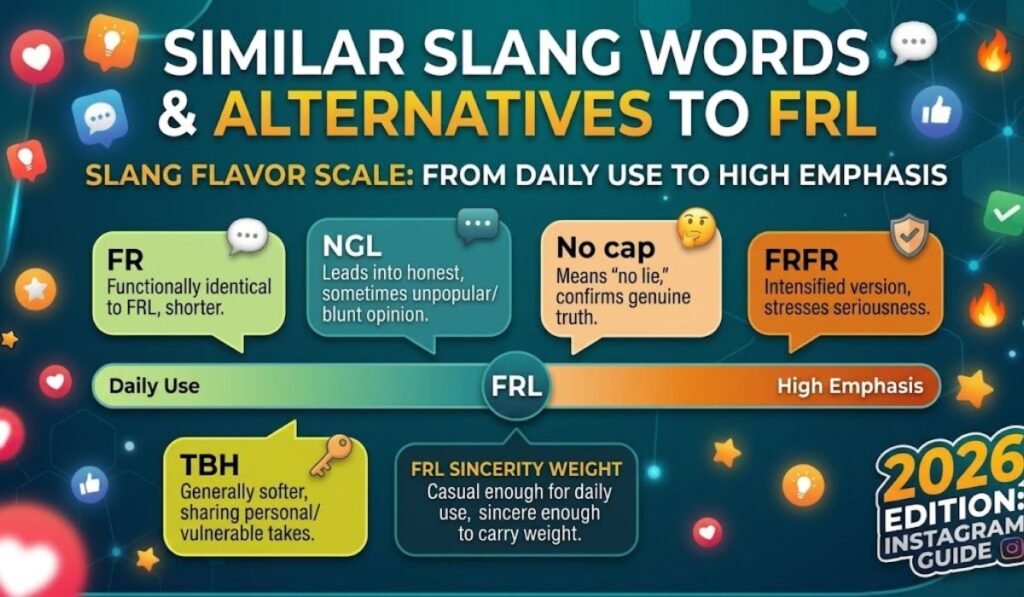
FRL isn’t the only way to express sincerity in a text. A few close alternatives each carry a slightly different flavor:
- FR — Functionally identical to FRL, just one letter shorter and slightly more common in casual texting.
- FRFR — An intensified version, used when someone really wants to stress how serious they are.
- NGL — Leads into an honest opinion, often one the speaker expects might be unpopular or blunt.
- TBH — Similar to NGL but generally softer, used when sharing a personal, sometimes vulnerable take.
- No cap — Means “no lie,” used to confirm something is genuinely true, often interchangeably with FRL.
Swapping between these depends on how much emphasis you want. FRL sits in the middle: casual enough for daily use, but sincere enough to carry weight when it matters.
Frequently Asked Questions About FRL Mean in Text
What does FRL mean in a text message?
FRL stands for “For Real.” It’s used to confirm something is true, react with surprise, or agree with what someone just said in a casual conversation.
Is FRL the same as FR?
Yes. FRL and FR both mean “For Real” and are used interchangeably. FR is slightly more common, but they carry identical meaning and tone.
Does FRL always mean “For Real”?
In the vast majority of texting contexts, yes. A less common variation stands for “For Real, Laughing,” but this depends heavily on surrounding context and isn’t the default meaning.
Is FRL offensive or rude?
No, FRL is a neutral, casual slang term. It’s not offensive on its own, though tone and context around it can shift how a message reads overall.
Can I use FRL in a professional setting?
It’s best avoided in work emails, job interviews, or formal writing. FRL is casual slang meant for texting friends and informal social media use.
What does FRL mean besides texting slang?
In education, FRL refers to Free and Reduced-Price Lunch, a federal program that provides meals at low or no cost to students from lower-income households.
How do I respond when someone texts “frl?”
Confirm with something like “yeah frl” if it’s true, or clarify with “nah, I was exaggerating” if it wasn’t meant literally.
Is FRL only used by teenagers?
It’s most common among teens and young adults, but it’s spread widely enough that people across various age groups use it in casual digital communication.
Conclusion
FRL is a simple, small piece of slang that carries real weight in casual conversation — it’s how people online say “I’m serious” without typing out the whole phrase. Whether you see it confirming a wild story, backing up an opinion, or showing up in a school’s demographic report with a totally different meaning, context is really what tells you how to read it. Once you know that, “frl” stops being confusing and starts being just another quick, natural way people talk to each other online.
