
You’re mid-conversation on Snapchat or Instagram and someone drops “DTB” at the end of their message. No explanation, no follow-up. You’re left wondering if you did something wrong or if you’re just missing out on the latest slang.
You’re not behind — DTB is one of those short texting abbreviations that only really clicks once someone breaks it down for you. Here’s exactly what DTB means, when people use it, and how it changes meaning depending on where you see it.
What Does DTB Mean in Text?
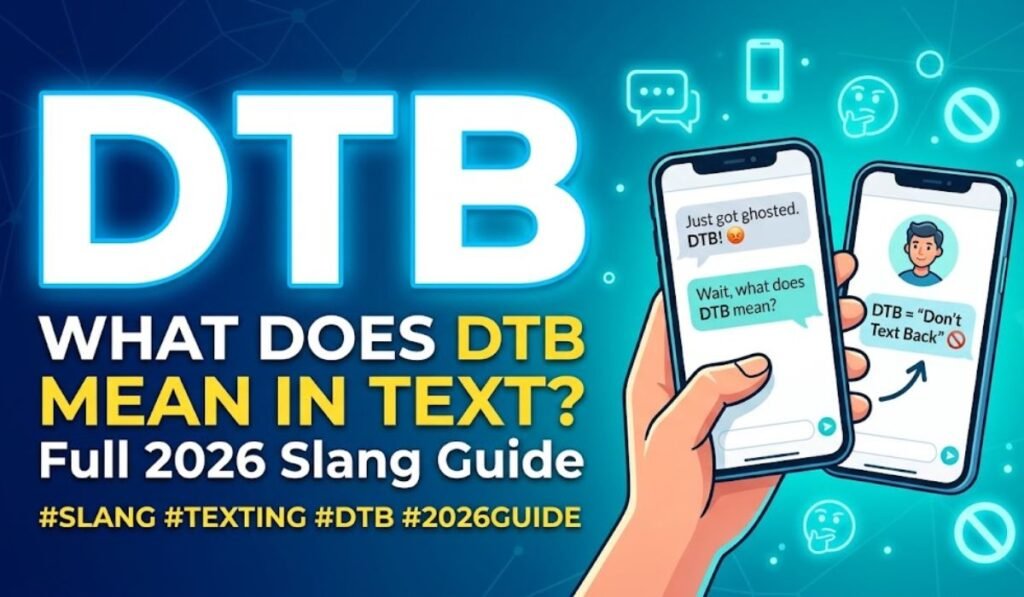
Quick Answer: DTB most commonly means “Don’t Text Back.” People add it to the end of a message to let the other person know a reply isn’t needed — usually because they’re busy, heading to sleep, or just want the last word. On TikTok and Instagram, it can also mean “Don’t Trust Boys” or a harsher variant aimed at people who feel burned by dating.
The core idea behind DTB as “Don’t Text Back” is simple: it’s a polite (or sometimes blunt) way to close a conversation. Instead of leaving someone hanging or wondering if you’ll reply, DTB tells them upfront that silence is expected. It works almost like an away message baked into a single text.
Another Meaning (Less Common)
The second major meaning of DTB comes from TikTok and social media culture, where it stands for “Don’t Trust Boys” or a more explicit version aimed at untrustworthy people in general. This usage started circulating in relationship-focused content and rap lyrics, and it’s now common in captions about breakups, red flags, or dating disappointments.
🧾 In short:
- DTB = Don’t Text Back — the most common meaning in everyday texting
- DTB = Don’t Trust Boys (or a similar phrase) — common in TikTok captions and relationship posts
- Context, platform, and tone decide which one applies
What Does DTB Mean on Instagram?
On Instagram, DTB shows up most often in DMs and captions. In direct messages, it usually keeps the “Don’t Text Back” meaning — someone signing off for the night or wrapping up a conversation. In captions or comments, especially under relationship-themed posts, DTB tends to lean toward the “Don’t Trust Boys” meaning, often paired with a knowing emoji or a sarcastic tone.
What Does DTB Mean on Snapchat?
Snapchat is where “Don’t Text Back” shows up the most naturally, since Snapchat conversations are already fast and casual. Someone might send “goodnight, DTB” before bed, or use it during a Snapchat streak when they want to pause the back-and-forth without breaking the streak itself. It’s a quick way to say “I saw this, no need to reply” without sounding cold.
DTB Meaning in Banking
Outside of texting, DTB has a completely unrelated meaning in finance. It commonly refers to Diamond Trust Bank, a regional bank operating across East Africa, particularly Kenya, Uganda, and Tanzania. In European financial contexts, DTB has also historically referred to the Deutsche Terminbörse, a former German derivatives exchange. If you come across DTB in a news article about banking or stock markets rather than a text message, this is almost certainly the meaning intended — it has nothing to do with texting slang.
📱 Where Is DTB Commonly Used?
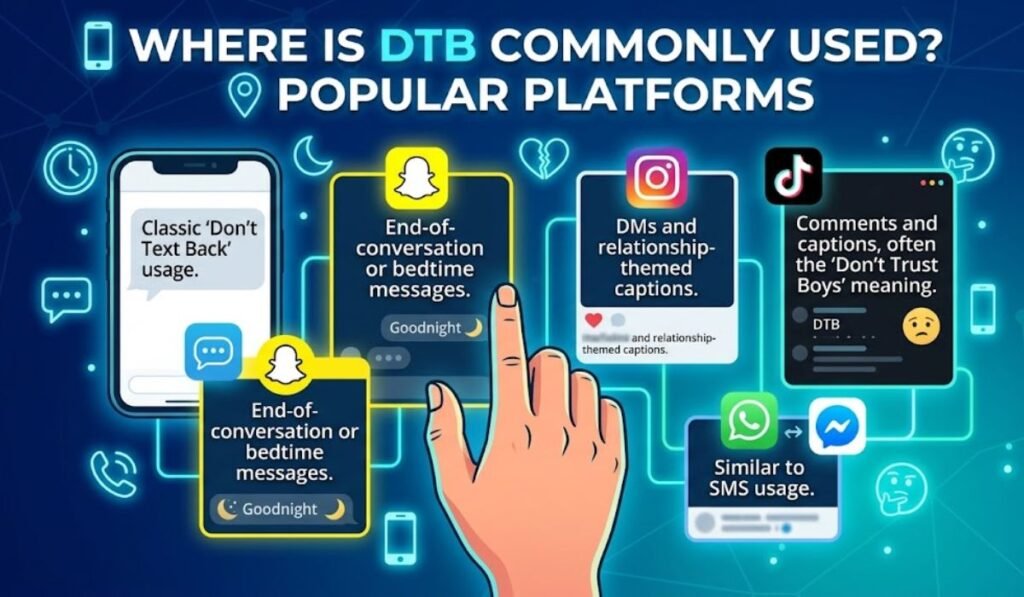
📍 Popular platforms:
- Texting/SMS — classic “Don’t Text Back” usage
- Snapchat — end-of-conversation or bedtime messages
- Instagram — DMs and relationship-themed captions
- TikTok — comments and captions, often the “Don’t Trust Boys” meaning
- WhatsApp and Facebook Messenger — similar to SMS usage
🧩 Tone & usage:
DTB is almost always informal. It fits casual conversations between friends, situationships, or peers, but it rarely appears in professional messages. The tone shifts based on wording around it — “I’m exhausted, DTB 😴” reads as gentle, while “leave me alone, DTB” reads as sharp and final.
💬 Examples of DTB in Conversation
1. Ending a conversation
Person A: I already told you how I feel about this. DTB.
Person B: Got it, talk later.
This use signals the sender considers the topic closed for now.
2. Sleeping message
Person A: Heading to bed, long day tomorrow. DTB 😴
Person B: Sleep well!
Here DTB simply means “no reply needed tonight,” not a cold shutdown.
3. Busy situation
Person A: In a meeting for the next hour, DTB
Person B: No worries, ping me after
A practical, low-drama use — the sender just can’t check their phone.
4. Emotional tone
Person A: I’m not doing this again with you. DTB.
This version carries more weight and often follows an argument or disagreement.
5. Friendly joke
Person A: Bro thinks he’s the main character today 💀 DTB
Person B: LMAOO facts
Used playfully among friends, often with humor rather than genuine annoyance.
6. Social media caption
Caption under a breakup-themed post: New era, new rules. DTB fr 💅
This leans toward the “Don’t Trust Boys” meaning, common in TikTok and Instagram captions.
🕓 When to Use and When Not to Use DTB
✅ When to Use DTB
- Wrapping up a late-night conversation before sleep
- Letting someone know you’re busy without ghosting them
- Signing off after saying everything you needed to say
- Casual banter with close friends who already know the term
❌ When Not to Use DTB
- Professional or work-related messages
- Conversations with someone unfamiliar with texting slang
- Serious or sensitive topics where clarity matters more than brevity
- First-time conversations, where it can come across as dismissive
🔄 Other Meanings of DTB in Text
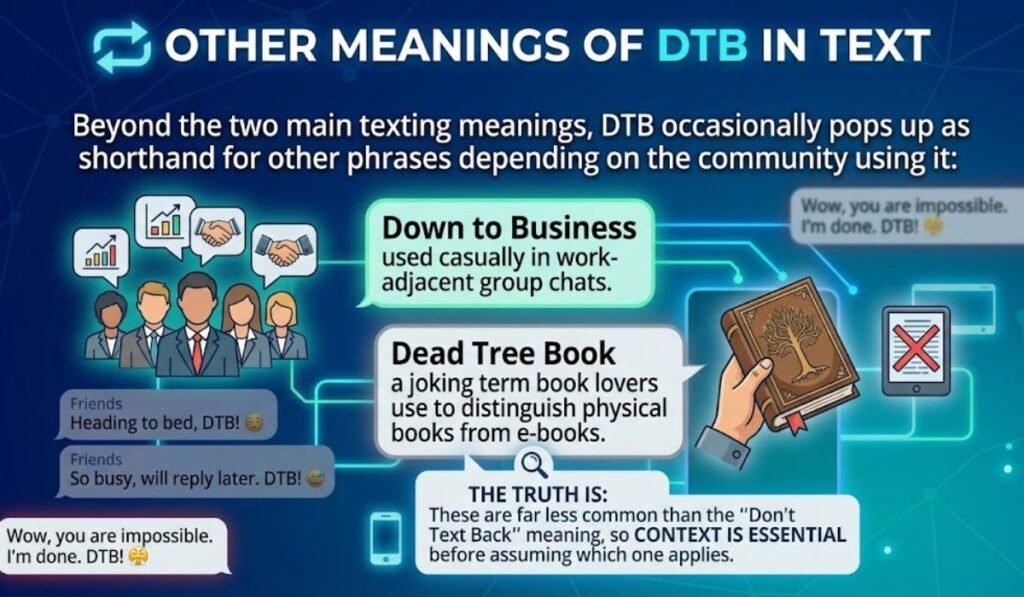
Beyond the two main texting meanings, DTB occasionally pops up as shorthand for other phrases depending on the community using it:
- “Down to Business” — used casually in work-adjacent group chats
- “Dead Tree Book” — a joking term book lovers use to distinguish physical books from e-books
These are far less common than the “Don’t Text Back” meaning, so context is essential before assuming which one applies.
🔄 Similar Slang Words or Alternatives To DTB
| Slang | Meaning | Typical Tone |
| DTB | Don’t Text Back | Neutral to blunt |
| BRB | Be Right Back | Temporary, expects a reply later |
| GTG | Got To Go | Ending a chat quickly |
| TTYL | Talk To You Later | Friendly pause, expects future reply |
| NRN | No Reply Needed | Softer, more explicit version of DTB |
The biggest difference between DTB and terms like BRB or TTYL is intent. BRB and TTYL both imply the conversation will pick back up. DTB signals the opposite — the sender doesn’t expect or want an immediate response, even if the conversation might continue later.
🧠 Why People Use DTB in Texting
⚡ 1. Saves Time
Typing three letters is faster than writing out a full sentence explaining you’re busy or heading offline.
📱 2. Keeps Conversations Short
Shorthand like DTB fits naturally into fast-paced messaging apps where long explanations feel unnecessary.
😎 3. Feels Modern
Using current slang, even something small like DTB, signals familiarity with how younger users communicate online.
🔥 4. Social Media Culture
Platforms like TikTok reward short, punchy captions, which is part of why DTB spread beyond texting into comments and posts.
🧾 Is DTB Rude or Normal?
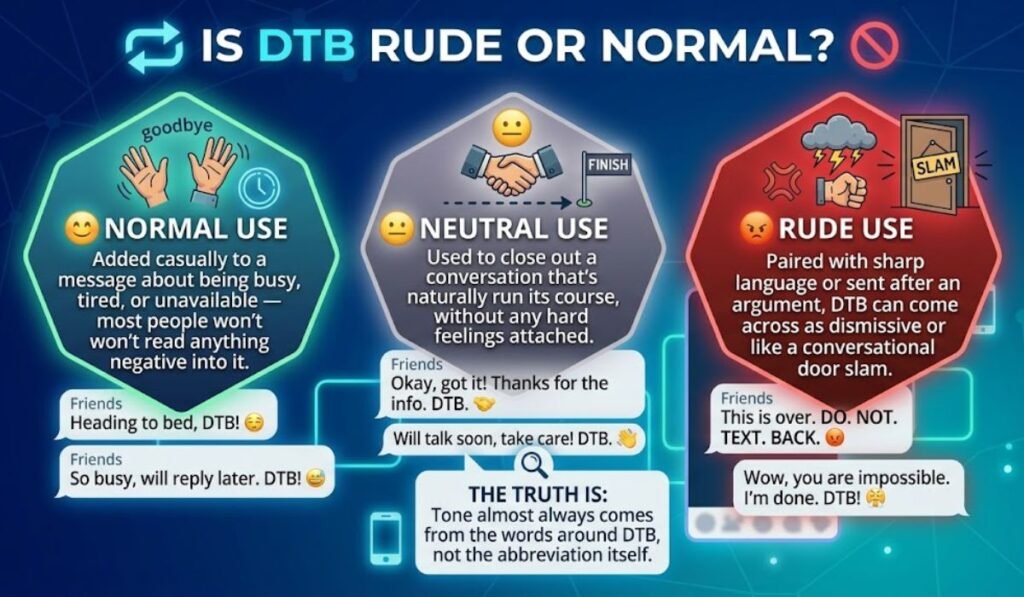
😊 Normal Use:
Added casually to a message about being busy, tired, or unavailable — most people won’t read anything negative into it.
😐 Neutral Use:
Used to close out a conversation that’s naturally run its course, without any hard feelings attached.
😠 Rude Use:
Paired with sharp language or sent after an argument, DTB can come across as dismissive or like a conversational door slam.
Tone almost always comes from the words around DTB, not the abbreviation itself.
Frequently Asked Questions About DTB Meaning in Text
What does DTB mean in a text message?
DTB most commonly means “Don’t Text Back.” It tells the recipient that a reply isn’t necessary, often because the sender is busy, tired, or done with the topic for now.
Does DTB always mean something negative?
No. DTB is often neutral or even friendly, especially when used before bed or during a busy moment. Tone and surrounding words determine whether it feels harsh or casual.
What does DTB mean on TikTok specifically?
On TikTok, DTB frequently means “Don’t Trust Boys,” especially in captions about dating, breakups, or relationship advice. It’s less common as “Don’t Text Back” on that platform.
Is DTB the same as leaving someone on read?
Not exactly. Leaving someone on read is passive, while DTB is an active statement telling the person not to expect a reply. It’s more direct than silence.
How do I reply if someone sends me DTB?
Usually, you don’t need to reply at all — that’s the point. If you want to acknowledge it, a short “okay” or emoji works fine without restarting the conversation.
Can DTB be used in professional messages?
It’s best avoided in professional or formal settings. DTB is casual slang suited for texting between friends, not workplace or business communication.
Why does DTB have so many different meanings?
Slang terms often get reused across different communities. “Don’t Text Back” started in everyday texting, while “Don’t Trust Boys” grew separately out of TikTok and relationship content, so both stuck around.
Is DTB used the same way in every country?
The “Don’t Text Back” meaning is widely understood in English-speaking texting culture, particularly in the US. Regional slang variations exist, but this remains the most recognized definition globally.
Final Thoughts
DTB is a small abbreviation that carries different weight depending on where you see it. In a text from a friend, it usually just means “no reply needed right now.” In a TikTok caption, it might carry a completely different message about trust in relationships. Paying attention to the platform, the words around it, and your relationship with the sender is the fastest way to read it correctly — no guessing required.
