

You say “thanks,” and the reply comes back instantly: “yw.” No capital letters, no punctuation, just two characters closing the loop. If you paused to figure out what that meant, you’re not the only one typing it into a search bar. YW is one of the most common short replies in texting, and once you know it, you’ll spot it everywhere from group chats to Instagram comments.
Quick Answer
YW stands for “you’re welcome.” People type it right after someone says “thank you” as a fast, casual way to acknowledge gratitude without writing out the full phrase. It shows up in texts, DMs, comments, and group chats, and it’s generally friendly — though tone can shift depending on who sends it and how.
What Does YW Mean After Thank You?
When someone replies with YW after you thank them, they’re simply telling you the favor wasn’t a big deal and you don’t owe them anything. It’s the digital version of nodding and saying “sure thing” in person.
Full Form of YW
YW is short for “you’re welcome.” That’s the primary and by far the most common meaning across texting apps, social platforms, and online chats.
Plain-English Explanation
Think of YW as a courtesy stamp. Someone helped you, thanked them, or thanked you, and instead of typing out two full words, they compressed it into two letters. The meaning doesn’t change — it’s just faster to send, especially on a phone keyboard mid-conversation.
YW Meaning in Text From a Guy
Guys often use YW the same way anyone else does: as a quick, low-effort acknowledgment. On its own, “yw” from a guy usually reads as neutral or friendly rather than cold — texting culture in general leans toward short replies regardless of gender. What changes the read is everything around it. “yw 😊” or “yw fr” tends to feel warm and easygoing. A flat “yw” with no punctuation after a longer, more emotional thank-you can come across as distant, but that’s a texting-style issue, not something specific to men. If the tone feels off, it’s worth looking at the rest of the conversation rather than the two letters alone.
YW Meaning Urban Dictionary
On slang-reference sites like Urban Dictionary, YW is listed primarily as “you’re welcome,” used as a reply to “ty” (thank you). Some entries also note joke or sarcastic definitions, such as “yeah, whatever,” used when someone wants to sound dismissive instead of polite. These alternate meanings exist, but they’re far less common — in the vast majority of everyday texts, YW is a straightforward, polite response to thanks.
Why People Use YW
Texting rewards speed. People use YW instead of “you’re welcome” for a few practical reasons:
- It’s faster to type, especially one-handed on a phone
- It matches the length and energy of a short “ty” or “thanks”
- It keeps a conversation moving without slowing things down
- It’s widely understood, so there’s little risk of confusion
None of this makes YW lazy — it’s just how casual digital conversation naturally compresses over time, the same way “brb” replaced “I’ll be right back.”
Short Example Sentence
“Thanks for grabbing my mail while I was away.” “yw, anytime!”
That single exchange covers the whole pattern: a short thank-you, followed by an even shorter acknowledgment.
Where Is YW Commonly Used?

YW isn’t limited to one app or platform. It travels across pretty much every place people type casually.
Common Places You’ll See YW
- Text messages (SMS and iMessage)
- Instagram and TikTok comments or DMs
- Snapchat chats
- WhatsApp conversations
- Discord and online gaming chats
- Informal Slack or workplace messages between friendly coworkers
Tone of YW
On its own, YW reads as neutral-to-friendly. Add an emoji, like “yw 😊” or “yw 👍,” and it softens further. Pair it with extra words, like “yw, no worries” or “yw, happy to help,” and it feels warmer and more genuine. A bare “yw” with nothing else isn’t rude by default, but in an emotional or serious conversation, it can land as a little flat simply because it’s so short.
Realistic Conversation Examples (Text Style)
Example 1 Friends
Maya: thanks for covering my shift today, you’re a lifesaver
Jordan: yw!! anytime
Example 2 — Social media comment
Comment: “Thank you for the shoutout, means a lot!”
Reply: “yw, you earned it 🙌”
Example 3 — Group chat
Sam: thanks everyone for helping me move this weekend
Priya: yw, that’s what friends are for
Alex: yw lol my back is still recovering
Example 4 — After an awkward moment
Riley: thanks for finally getting back to me
Casey: yw
In the last example, the missing emoji and short reply can feel a little curt — a reminder that context shapes how YW is read far more than the letters themselves.
The Simple Explanation Everyone’s Searching For
If you strip away every nuance, here’s the one-line version: YW = you’re welcome, sent after someone says thanks. That’s it. Everything else — tone, platform, emojis — just adds shading to that one core meaning.
When to Use and When Not to Use YW
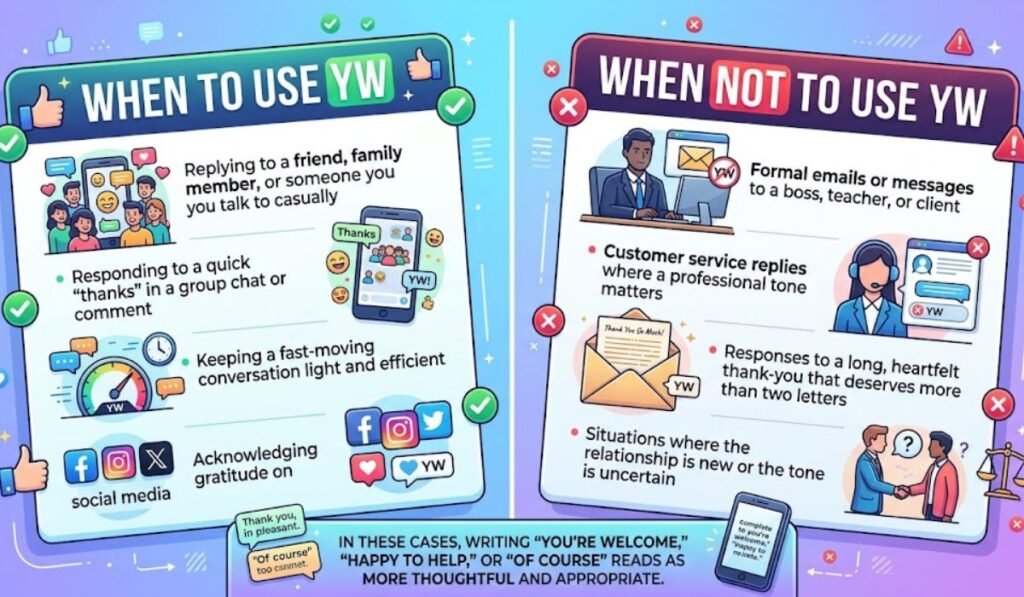
When to Use YW
- Replying to a friend, family member, or someone you talk to casually
- Responding to a quick “thanks” in a group chat or comment
- Keeping a fast-moving conversation light and efficient
- Acknowledging gratitude on social media
When Not to Use YW
- Formal emails or messages to a boss, teacher, or client
- Customer service replies where a professional tone matters
- Responses to a long, heartfelt thank-you that deserves more than two letters
- Situations where the relationship is new or the tone is uncertain
In those cases, writing “you’re welcome,” “happy to help,” or “of course” reads as more thoughtful and appropriate.
Comparison Table
| Term | Meaning | Best Used For |
| YW | You’re welcome | Casual texts, comments, DMs |
| NP | No problem | Quick, laid-back replies |
| Anytime | Willing to help again | Friendly, ongoing relationships |
| My pleasure | Glad to help | Slightly more polite or professional tone |
| You’re welcome (full) | Standard polite reply | Formal or emotional conversations |
Similar Slang Words or Alternatives
YW isn’t the only short way to answer a thank-you, and each option carries a slightly different feel:
- NP (“no problem”) — casual, suggests the favor was effortless
- Anytime — implies openness to helping again in the future
- NBD (“no big deal”) — downplays the effort even more than YW
- Sure / of course — friendly but slightly more grounded than a pure abbreviation
- My pleasure — leans more polite, works better in semi-professional settings
None of these are wrong; they just shift the tone from purely efficient (YW, NP) to warmer or more formal (my pleasure, of course).
Where YW Comes From
YW traces back to early internet chatrooms and instant messaging in the 1990s and 2000s, when character limits and slow typing speeds pushed people toward abbreviations. It grew alongside similar shortcuts like “ty” (thank you), “np” (no problem), and “brb.” As SMS texting and then smartphone messaging apps took over, YW carried on as one of the standard, unremarkable replies built into everyday digital manners.
Does YW Mean Something Different by Generation?
The core meaning hasn’t changed across age groups — YW still means “you’re welcome” whether it’s sent by a teenager or a parent. What does shift is frequency and comfort level. Younger texters tend to use it automatically, often without a second thought, while older users may still default to typing “you’re welcome” in full, reserving YW for casual moments with peers who use it too. Neither approach is more correct; it’s simply a matter of habit.
How to Reply to YW
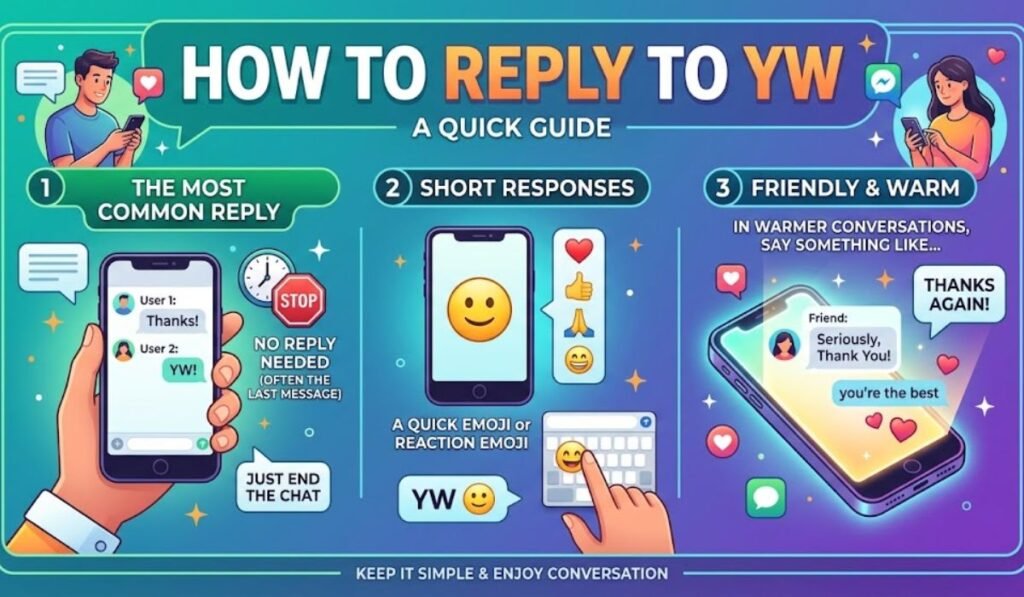
Most of the time, YW doesn’t need a reply at all — it’s often the last message in a thank-you exchange. If you do want to respond, a short reaction emoji, a simple “🙂,” or moving on to the next topic works fine. In warmer conversations, something like “you’re the best” or “seriously, thank you” can round things off nicely without feeling required.
Common Misunderstandings
The biggest mix-up with YW is reading too much emotion into a short reply. A plain “yw” isn’t automatically sarcastic or annoyed — it’s often just efficient texting. Misreadings tend to happen when people forget that tone doesn’t travel well through text, so a message that felt neutral to the sender can feel cold to the reader. When in doubt, context from the rest of the conversation is a better guide than the two letters alone.
Frequently Asked Questions
What does YW mean after thank you in a text?
YW means “you’re welcome.” It’s a short, casual reply people send right after someone says “thanks” or “thank you” in a text or chat.
Is YW rude or dismissive?
Not by default. A bare “yw” can feel a little flat in emotional conversations, but in casual texting it’s simply a fast, polite acknowledgement, not a sign of rudeness.
Does YW mean the same thing on every platform?
Yes, the core meaning stays consistent across texting, Instagram, Snapchat, TikTok, and WhatsApp. What changes is the formality expected on each platform.
Can YW mean something other than “you’re welcome”?
Occasionally. In rare, mostly sarcastic contexts, YW has been used for “yeah, whatever.” This is uncommon, and the vast majority of the time it simply means “you’re welcome.”
Is it okay to use YW with a boss or teacher?
It’s better to avoid it. In formal or professional settings, writing out “you’re welcome” or “happy to help” comes across as more respectful and polished.
What’s the difference between YW and NP?
Both are quick thank-you responses. YW directly means “you’re welcome,” while NP (“no problem”) emphasizes that the favor wasn’t an inconvenience.
Do I need to reply to someone who sends YW?
No. YW usually ends a thank-you exchange naturally. A reaction emoji or simply moving on is completely normal.
Why do people use YW instead of typing it out?
It’s quicker to type, matches the short, fast pace of texting, and is widely understood, so it saves time without losing the meaning.
Final Thought
YW is a small piece of texting shorthand that does a big job: it closes out a thank-you politely and quickly. In casual chats, comments, and DMs, it works perfectly well on its own or dressed up with an emoji. Save the full “you’re welcome” for formal messages or moments that deserve more than two letters, and you’ll rarely misjudge how to respond to — or send — a thank-you again.
